The displacement of a particle is given at time $t$, by:$x=A \sin (-2 \omega t)+B \sin ^2 \omega t \quad$ Then,
Medium


Download our appand get started for free
Experience the future of education. Simply download our apps or reach out to us for more information. Let's shape the future of learning together!No signup needed.*
Similar Questions
- 1A particle of mass $m$ is located in a one dimensional potential field where potential energy is given by : $V(x) = A(1 -cos\, px)$ ,View Solution
where $A$ and $p$ are constant.
The period of small oscillations of the particle is
- 2A body executing $S.H.M.$ along a straightline has a velocity of $3 \,ms ^{-1}$ when it is at a distance of $4 \,m$ from its mean position and $4 \,ms ^{-1}$ when it is at a distance of $3 \,m$ from its mean position. Its angular frequency and amplitude areView Solution
- 3Which of the following expressions corresponds to simple harmonic motion along a straight line, where $x$ is the displacement and $a, b, c$ are positive constants?View Solution
- 4The function $sin^2\,(\omega t)$ representsView Solution
- 5A block with mass $M$ is connected by a massless spring with stiffiess constant $k$ to a rigid wall and moves without friction on a horizontal surface. The block oscillates with small amplitude $A$ about an equilibrium position $x_0$. Consider two cases: ($i$) when the block is at $x_0$; and ($ii$) when the block is at $x=x_0+A$. In both the cases, a perticle with mass $m$ is placed on the mass $M$ ?View Solution
($A$) The amplitude of oscillation in the first case changes by a factor of $\sqrt{\frac{M}{m+M}}$, whereas in the second case it remains unchanged
($B$) The final time period of oscillation in both the cases is same
($C$) The total energy decreases in both the cases
($D$) The instantaneous speed at $x_0$ of the combined masses decreases in both the cases
- 6View SolutionA simple pendulum hangs from the ceiling of a car. If the car accelerates with a uniform acceleration, the frequency of the simple pendulum will
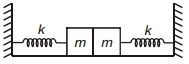
- 7View SolutionAn assembly of identical spring-mass systems is placed on a smooth horizontal surface as shown. At this instant, the springs are relaxed. The left mass is displaced to the/left and theiright mass is displaced to the right by same distance and released. The resulting collision is elastic. The time period of the oscillations of system is
- 8A vibratory motion is represented by $x = 2A\,\cos \omega t + A\,\cos \,\left( {\omega t + \frac{\pi }{2}} \right) + A\,\cos \,\left( {\omega t + \pi } \right)$ $ + \frac{A}{2}\,\cos \left( {\omega t + \frac{{3\pi }}{2}} \right)$. The resultant amplitude of the motion isView Solution
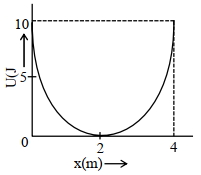
- 9A mass of $5\, {kg}$ is connected to a spring. The potential energy curve of the simple harmonic motion executed by the system is shown in the figure. A simple pendulum of length $4\, {m}$ has the same period of oscillation as the spring system. What is the value of acceleration due to gravity on the planet where these experiments are performed? (In ${m} / {s}^{2}$)View Solution
- 10The equation of an $S.H.M.$ with amplitude $A$ and angular frequency $\omega$ in which all the distances are measured from one extreme position and time is taken to be zero at the other extreme position is ...View Solution