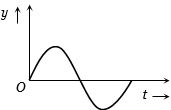
The displacement time graph of a particle executing $S.H.M.$ is as shown in the figureThe corresponding force-time graph of the particle is
Easy
Download our app for free and get started
(d)Acceleration $ = - {\omega ^2}y.$ So $F = - m{\omega ^2}y$
$y$ is sinusoidal function.
So $F$ will be also sinusoidal function with phase difference $\pi$
$y$ is sinusoidal function.
So $F$ will be also sinusoidal function with phase difference $\pi$

Download our appand get started for free
Experience the future of education. Simply download our apps or reach out to us for more information. Let's shape the future of learning together!No signup needed.*
Similar Questions
- 1The angular frequency of the damped oscillator is given by, $\omega = \sqrt {\left( {\frac{k}{m} - \frac{{{r^2}}}{{4{m^2}}}} \right)} $ where $k$ is the spring constant, $m$ is the mass of the oscillator and $r$ is the damping constant. If the ratio $\frac{{{r^2}}}{{mk}}$ is $8\%$, the change in time period compared to the undamped oscillator is approximately as followsView Solution
- 2The force constants of two springs are ${K_1}$ and ${K_2}$. Both are stretched till their elastic energies are equal. If the stretching forces are ${F_1}$ and ${F_2}$, then ${F_1}:{F_2}$ isView Solution
- 3A particle executes simple harmonic motion with an amplitude of $4 \mathrm{~cm}$. At the mean position, velocity of the particle is $10 \mathrm{~cm} / \mathrm{s}$. The distance of the particle from the mean position when its speed becomes $5 \mathrm{~cm} / \mathrm{s}$ is $\sqrt{\alpha} \mathrm{cm}$, where $\alpha=$____________.View Solution
- 4View SolutionThe phase difference between the instantaneous velocity and acceleration of a particle executing simple harmonic motion is
- 5A $1.00 \times {10^{ - 20}}kg$ particle is vibrating with simple harmonic motion with a period of $1.00 \times {10^{ - 5}}sec$ and a maximum speed of $1.00 \times {10^3}m/s$. The maximum displacement of the particle isView Solution
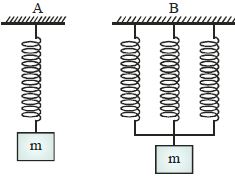
- 6The springs in figure. $A$ and $B$ are identical but length in $A$ is three times that in $B$. The ratio of period $T_A/T_B$ isView Solution
- 7A simple pendulum with length $L$ and mass $m$ of the bob is vibrating with an amplitude $A$. The maximum tension in the string isView Solution
- 8View SolutionA particle is moving in a circle with uniform speed. Its motion is
- 9A simple pendulum is suspended from the roof of a trolley which moves in a horizontal direction with an acceleration $a$, then the time period is given by $T = 2\pi \sqrt {\frac{l}{{g'}}} $, where $g'$ is equal toView Solution
- 10If a spring extends by $x$ on loading, then energy stored by the spring is (if $T$ is the tension in the spring and $K$ is the spring constant)View Solution