The drift velocity of free electrons in a conductor is ‘$v$’ when a current ‘$i$’ is flowing in it. If both the radius and current are doubled, then drift velocity will be
Easy


Download our appand get started for free
Experience the future of education. Simply download our apps or reach out to us for more information. Let's shape the future of learning together!No signup needed.*
Similar Questions
- 1Three resistances, each of $1\, ohm$, are joined in parallel. Three such combinations are put in series, then the resultant resistance will be ............. $ohm$View Solution
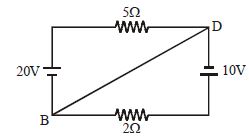
- 2Calculate the current in wire $BD$ ................ $A$View Solution
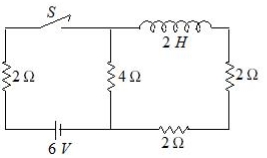
- 3For the given circuit the current through battery of $6\,V$ just after closing the switch ' $S$ ' will be$.......A$.View Solution
- 4A constant electric current $I$ is passed through a straight conductor of length $l$. If $S$ in specific charge of electron then the total momentum of electrons isView Solution
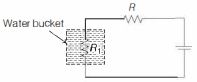
- 5View SolutionThe circuit below is used to heat water kept in a bucket. Assuming heat loss only by Newton's law of cooling, the variation in the temperature of the water in the bucket as a function of time is depicted by
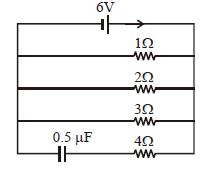
- 6View SolutionIn the given circuit diagram the current through the battery and the charge on the capacitor respectively in steady state are
- 7A material '$B$' has twice the specific resistance of '$A$'. A circular wire made of '$B$' has twice the diameter ofa wire made of '$A$'. then for the two wires to have the same resistance, the ratio $\frac{{{l_B}}}{{{l_A}}}$ of their respective lengths must beView Solution
- 8Which of the four resistances $P, Q, R$ and $S$ generate the greatest amount of heat when a current flows from $A$ to $B$ ?View Solution
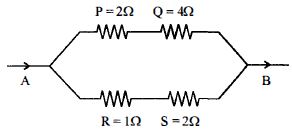
- 9In the given figure, when galvanometer shows no deflection, the current (in $A$) flowing through $5\,\Omega $ resistance will beView Solution
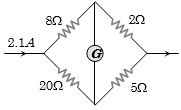
- 10In Wheatstone's bridge $P = 9\, ohm$, $Q = 11\, ohm$, $R = 4\,ohm$ and $S = 6\,ohm$. How much resistance must be put in parallel to the resistance $S$ to balance the bridge ............... $ohm$View Solution