MCQ
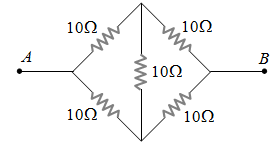
The effective resistance between points $A$ and $B$ is
  • $10 \Omega$
  • B
    $20 \Omega$
  • C
    $40 \Omega$
  • D
    None of the above three values

Answer

Correct option: A.
$10 \Omega$
$10 \Omega$

Need a full question paper?

Generate a complete, print-ready paper with questions like this in minutes — across 16+ boards, with answer keys.

Start Generating Free

Similar questions

In order to pass 10% of main current through a moving coil galvanometer of 99 ohm, the resistance of the required shunt is(a) 9.9 Ω(b) 10 Ω(c) 11 Ω(d) 9 Ω
       
As the quantum number increases, the difference of energy between consecutive energy levels?
According to the theory of relativity, all laws of nature are the same in reference frames that::
Consider the following two statements $A$ and $B$ and identify the correct choice given in the answers
$(A)$ Duddells thermo$-$galvanometer is suitable to measure direct current only
$(B)$ Thermopile can measure temperature differences of the order of $10^{-3}{ }^{\circ} \mathrm{C}$
When we touch the terminals of a high voltage capacitor, even after a high voltage has been cut off, then the capacitor has a tendency to(a) Restore energy(b) Discharge energy(c) Affect dangerously(d) Both (b) and (c)
       
Zener breakdown takes place if:
Current is flowing in a circular coil of radius r. There are n turns in the coil. Its magnetic moment varies with r. As:
Usually the mirror installed in front of the motor driver's seat is:
A block is placed on a rough floor and a horizontal force F is applied on it. The force of friction f by the floor on the block is measured for different values of F and a graph is plotted between them.
  1. The graph is a straight line of slope 45°.
  2. The graph is a straight line parallel to the F-axis.
  3. The graph is a straight line of slope 45° for small F and a straight line parallel to the F-axis for large F.
  4. There is a small kink on the graph.
What is the amount of work done to bring a charge of $4 \times 10^{-3}C$ charge from infinity to a point whose electric potential is $2 \times 10^2V?$