MCQ
The elastic limit for a gas
  • Exists
  • B
    Exists only at absolute zero
  • C
    Exists for a perfect gas
  • D
    Does not exist

Answer

Correct option: A.
Exists
a
(a)

Need a full question paper?

Generate a complete, print-ready paper with questions like this in minutes — across 16+ boards, with answer keys.

Start Generating Free

Similar questions

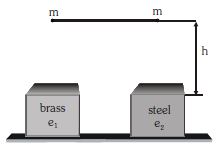
A dumbbell consisting of two masses $m$ each, connected by a light rigid rod of length $l$, falls on two pads of equal height, one steel and the other brass through a height $h$. The coefficient of restitution are $e_1$ and $e_2$ ($e_1 < e_2$). To what maximum height will the centre of mass of the dumbbell rise after bouncing of the pads?
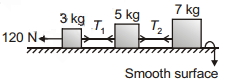
$T_1$ and $T_2$ in the given figure are
A girl standing on road holds her umbrella at $45^{\circ}$ with the vertical to keep the rain away. If she starts running without umbrella with a speed of $15 \sqrt{2} \; kmh ^{-1}$, the rain drops hit her head vertically. The speed of rain drops with respect to the moving girl is ...........  $kmh ^{-1}$
When an object is shot from the bottom of a long smooth inclined plane kept at an angle $60^{\circ}$ with horizontal. it can travel a distance $\mathrm{x}_{1}$ along the plane. But when the inclination is decreased to $30^{\circ}$ and the same object the shot with the same velocity, it can travel $x_{2}$ distance. Then $x_{1}: x_{2}$ will be
Two bodies at different temperatures are mixed in a calorimeter. Which of the following quantities remains conserved?
A man of mass M is standing at the centre of a rotating turn table rotating with an angular velocity $\omega.$ The man holds two 'dumb bells' of mass $\frac{\text{M}}{4}$ each in each of his two hands. If he stretches his arms to a horizontal position, the turn table acquires a new angular velocity $\omega'$ where
An aluminium sphere is dipped into water at 10°C. If the temperature is increased, the force of buoyancy:
  1. Will increase.
  2. Will decrease.
  3. Will remain constant.
  4. May increase or decrease depending on the radius of the sphere.
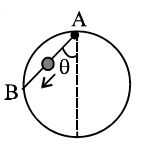
A bead is free to slide down a smooth wire tightly stretched between points $A$ and $B$ on a vertical circle. If the bead starts from rest at $A$, the highest point on the circle
Which of the following speed-time $(v-t)$ graphs is physically not possible?
A $100\,m$ long wire having cross-sectional area $6.25 \times 10^{-4}\,m ^2$ and Young's modulus is $10^{10}\,Nm ^{-2}$ is subjected to a load of $250\,N$, then the elongation in the wire will be :