MCQ
The electric current passing through a metallic wire produces heat because of
  • A
    Collisions of conduction electrons with each other
  • B
    Collisions of the atoms of the metal with each other
  • The energy released in the ionization of the atoms of the metal
  • D
    Collisions of the conduction electrons with the atoms of the metallic wires
Answer

Correct option: C.
The energy released in the ionization of the atoms of the metal
(c)

Need a full question paper?

Generate a complete, print-ready paper with questions like this in minutes — across 16+ boards, with answer keys.

Start Generating Free

Similar questions

The angle of a prism is $60^{\circ}$ and its refractive index is $\sqrt{2}$. The angle of minimum deviation suffered by a ray of light in passing through it is
Ratio between total intensity of magnetic field at equator to poles is
The length of a magnet is large compared to its width and breadth. The time period of its oscillation in a vibration magnetometer is $2 \mathrm{~s}$. The magnet is cut along its length into three equal parts and three parts are then placed on each other with their like poles together. The time period of this combination will be
The speed of electromagnetic wave in vacuum depends upon the source of radiation
The parts of motor cars are polished by chromium because the angle of contact between water and chromium is
If the Earth losses its gravity, then for a body
A car travels the first half of a distance between two places at a speed of $30 km / hr$ and the second half of the distance at $50 km / hr$. The average speed of the car for the whole journey is
If a spring has time period $T$, and is cut into $n$ equal parts, then the time period of each part will be
The magnifying power of a telescope is $9$ . When it is adjusted for parallel rays, the distance between the objective and the eye $-$ piece is found to be $20 \mathrm{~cm}$. The focal length of the two lenses are
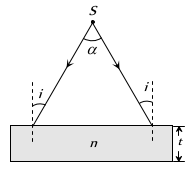
A diverging beam of light from a point source $S$ having divergence angle $\alpha$, falls symmetrically on a glass slab as shown. The angles of incidence of the two extreme rays are equal. If the thickness of the glass slab is $t$ and the refractive index $n$, then the divergence angle of the emergent beam is