MCQ
The electron in a hydrogen atom first jumps from the third excited state to the second excited state and subsequently to the first excited state. The ratio of the respective wavelengths, $\lambda _1/\lambda _2$, of the photons emitted in this process is
  • $20/7$
  • B
    $7/5$
  • C
    $9/7$
  • D
    $27/5$

Answer

Correct option: A.
$20/7$
a
$\frac{1}{\lambda } = R\left( {\frac{1}{{n_f^2}} - \frac{1}{{n_i^2}}} \right);$ $\frac{1}{{{\lambda _1}}} = R\left( {\frac{1}{{{3^2}}} - \frac{1}{{{4^2}}}} \right)$

$\frac{1}{{{\lambda _1}}} = R\left( {\frac{7}{{9 \times 16}}} \right);$ $\frac{1}{{{\lambda _2}}} = R\left( {\frac{1}{{{2^2}}} - \frac{1}{{{3^2}}}} \right)$

$=R\left(\frac{5}{4 \times 9}\right)$

$\frac{\lambda_{1}}{\lambda_{2}}=\frac{\frac{5}{36}}{\frac{7}{9 \times 16}}=\frac{20}{7}$

Need a full question paper?

Generate a complete, print-ready paper with questions like this in minutes — across 16+ boards, with answer keys.

Start Generating Free

Similar questions

A bar magnet of magnetic moment $\overrightarrow M $ is placed in a magnetic field of induction $\overrightarrow B $. The torque exerted on it is
A condenser of capacity $C$ is charged to a potential difference of $V_1$ . The plates of the condenser are then connected to an ideal inductor of inductance $L$. The current through the inductor when the potential difference across the condenser reduces to $V_2$ is
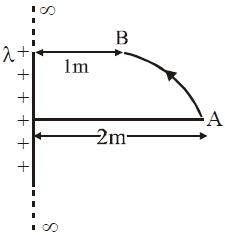
Figure shows a positively charged infinite wire. $A$ particle of charge $2C$ moves from point $A$ to $B$ with constant speed. (Given linear charge density on wire is $\lambda = 4 \pi \varepsilon_0$)
The formula for induced e.m.f. in a coil due to change in magnetic flux through the coil is (here A = area of the coil, B = magnetic field)
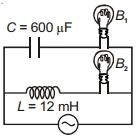
In the circuit shown in figure, if both the bulbs $B_1$ and $B_2$ are identical then
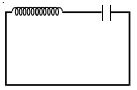
In an $LC$ circuit, the capacitor has maximum charge $q_0$. The value of is ${\left. {\frac{{di}}{{dt}}} \right|_{\max }}$
Which of the following quantities is zero on an average for the molecules of an ideal gas in equilibrium?
A convex lens
What is shape of magnet in moving coil galvanometer to make the radial magnetic field?
A stream of photons having energy $3 \,eV$ each impinges on a potassium surface. The work function of potassium is $2.3 \,eV$. The emerging photo-electrons are slowed down by a copper plate placed $5 \,mm$ away. If the potential difference between the two metal plates is $1 \,V$, the maximum distance the electrons can move away from the potassium surface before being turned back is .......... $mm$