MCQ
The electrostatic force between the metal plates of an isolated parallel plate capacitor C having a charge Q and area A, is:
  • A
    Independent of the distance between the plates.
  • B
    Linearly proportional to the distance between the plates.
  • C
    Inversely proportional to the distance between theplates.
  • D
    Proportional to the square root of the distance betweenthe plates.

Answer

  1. Independent of the distance between the plates.

Need a full question paper?

Generate a complete, print-ready paper with questions like this in minutes — across 16+ boards, with answer keys.

Start Generating Free

Similar questions

In a biprism experiment, by using light of wavelength 5000 Å, 5 mm wide fringes are obtained on a screen 1.0 m away from the coherent sources. The separation between the two coherent sources is

(a) 1.0 mm

(b) 0.1 mm

(c) 0.05 mm

(d) 0.01 mm

Peltier co-efficient of a thermo couple is 2 nano volts. How much heat is developed at a junction if 2.5 amp current flows for 2 minute

(a) 6 ergs 

(b) 6  

(c) 16 ergs

(d) 6  

A man is 180 cm tall and his eyes are 10 cm  below the top of his head. In order to see his entire height right from toe to head, he uses a plane mirror kept at a distance of 1m from him. The minimum length of the plane mirror required is

(a) 180 cm

(b) 90 cm

(c) 85 cm

(d) 170 cm

Which of the following sometimes requires initiation from a neutron?

Four charges are placed on corners of a square as shown in figure having side of 5cm. If Q is one microcoulomb, then electric field intensity at centre will be

(a) 1.02  upwards

(b) 2.04  downwards

(c) 2.04  upwards

(d) 1.02  downwards

An element X has mass number 10, and number of neutrons = 7. Then what will be the number of proton?

The valence of an impurity added to germanium crystal in order to convert it into a P-type semi conductor is

(a) 6 

(b) 5

(c) 4  

(d) 3

The resistance of 1 A ammeter is 0.018 Ω . To convert it into 10 A ammeter, the shunt resistance required will be

(a) 0.18 Ω

(b) 0.0018 Ω

(c) 0.002 Ω

(d) 0.12 Ω

An electron is ejected from the surface of a long, thick straight conductor carrying a current, initially in a direction perpendicular to the conductor. The electron will:

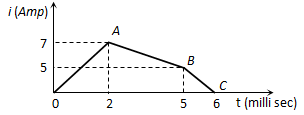
The current through a 4.6 H inductor is shown in the following graph. The induced emf during the time interval t = 5 milli-sec to 6 milli-sec will be

(a) 103

(b) – 23 × 103 V

(c) 23 × 103 V

(d) Zero