MCQ
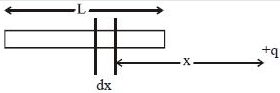
The electrostatic force of interaction between an uniformly charged rod having total charge $Q$ and length $L$ and a point charge $q$ as shown in figure is

  • $\frac{1}{{4\pi { \in _0}}}\frac{{qQ}}{{d(d + L)}}$
  • B
    $\frac{1}{{4\pi { \in _0}}}\frac{4{qQ}}{{(2d + L)^2}}$
  • C
    $\frac{1}{{4\pi { \in _0}}}\frac{{Qq}}{{d^2}}$
  • D
    $\frac{1}{{4\pi { \in _0}}}\frac{{qQ}}{{{{(d + L)}^2}}}$
Answer

Correct option: A.
$\frac{1}{{4\pi { \in _0}}}\frac{{qQ}}{{d(d + L)}}$
a
$\int {{\rm{dF}}}  = \int_0^{{\rm{d}} - {\rm{L}}} {\frac{1}{{4\pi { \in _0}}}} \frac{{\left( {\frac{{\rm{Q}}}{{\rm{L}}}{\rm{dx}}} \right){\rm{q}}}}{{{{\rm{x}}^2}}}$

$\Rightarrow \mathrm{F}=\frac{1}{4 \mathrm{n} \in_{0}} \frac{\mathrm{qQ}}{\mathrm{L}}\left|\frac{1}{-\mathrm{x}}\right|_{\mathrm{d}}^{\mathrm{d}+\mathrm{L}}$

$F = \frac{1}{{4\pi { \in _0}}}\frac{{Qq}}{L}\left[ { - \frac{1}{{d + L}} + \frac{1}{d}} \right]$

$ = \frac{1}{{4\pi { \in _0}}}\frac{{qQ}}{L}\left[ {\frac{{ - d + d + L}}{{d(d + L)}}} \right]$

${\rm{F}} = \frac{1}{{4\pi { \in _0}}}\frac{{{\rm{qQ}}}}{{{\rm{d}}({\rm{d}} + {\rm{L}})}}$

Need a full question paper?

Generate a complete, print-ready paper with questions like this in minutes — across 16+ boards, with answer keys.

Start Generating Free

Similar questions

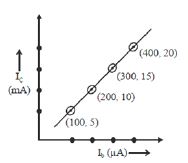
The transfer characteristic curve of a transistor, having input and output resistance $100\,\Omega $ and $100\,k\Omega $ respectively, is shown in the figure. The Voltage and Power gain, are respectively
If a magnet is hanged with its magnetic axis then it stops in
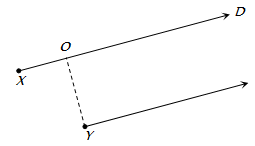
Two point sources X and Y emit waves of same frequency and speed but Y lags in phase behind X by 2pl radian. If there is a maximum in direction D the distance XO using n as an integer is given by
What kind of image is obtained always for concave lens?
 In a $YDSE$ bi-choromatic light of wavelength $400\, nm$ and $560\, nm$ are used. The distance betweenmthe slits is $0.1\, mm$ and the distance between the plane of the slits and the screen is $1\,m$. The minimum distance between two successive regions of complete darkness is.......$mm$
The tangent at any point of field line gives the direction of:
A nucleus has mass number $A_1$ and volume $V_1$.

Another nucleus has mass number $A_2$ and volume $V_2$. If relation between mass number is $A_2=4 A_1$, then $\frac{V_2}{V_1}=$_____.

Assertion : A bar magnet is dropped into a long vertical copper tube. Even taking air resistance as negligible, the magnet attains a constant terminal velocity. If the tube is heated, the terminal velocity gets increased.
Reason : The terminal velocity depends on eddy current produced in bar magnet.
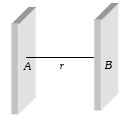
There are two equipotential surface as shown in figure. The distance between them is $r$. The charge of $-q\,$ coulomb is taken from the surface $A$ to $B$, the resultant work done will be
A capacitor is a perfect insulator for