Question
The equation for the vibration of a string, fixed at both ends vibrating in its third harmonic, is given by

$\text{y}=(0.4\text{cm})\sin\big[(0.314\text{cm}^{-1})\text{x}\big]\cos\big[(600\pi\text{s}^{-1})\text{t}\big]$

  1. What is the frequency of vibration?
  2. What are the positions of the nodes?
  3. What is the length of the string?
  4. What is the wavelength and the speed of two travelling waves that can interfere to give this vibration ?
Answer

The stationary wave equation is given by

$\text{y}(0.4\text{cm})\sin\big[(0.314\text{cm}^{-1})\text{x}\big]\cos\big[(600\pi\text{s}^{-1})\text{t}\big]$

  1. $\omega=600\pi\Rightarrow2\pi\text{f}=600\pi\Rightarrow\text{f}=300\text{Hz}$

Wavelength,, $\lambda=\frac{2\pi}{0.314}=\frac{(2\times3.14)}{0.314}=20\text{cm}$

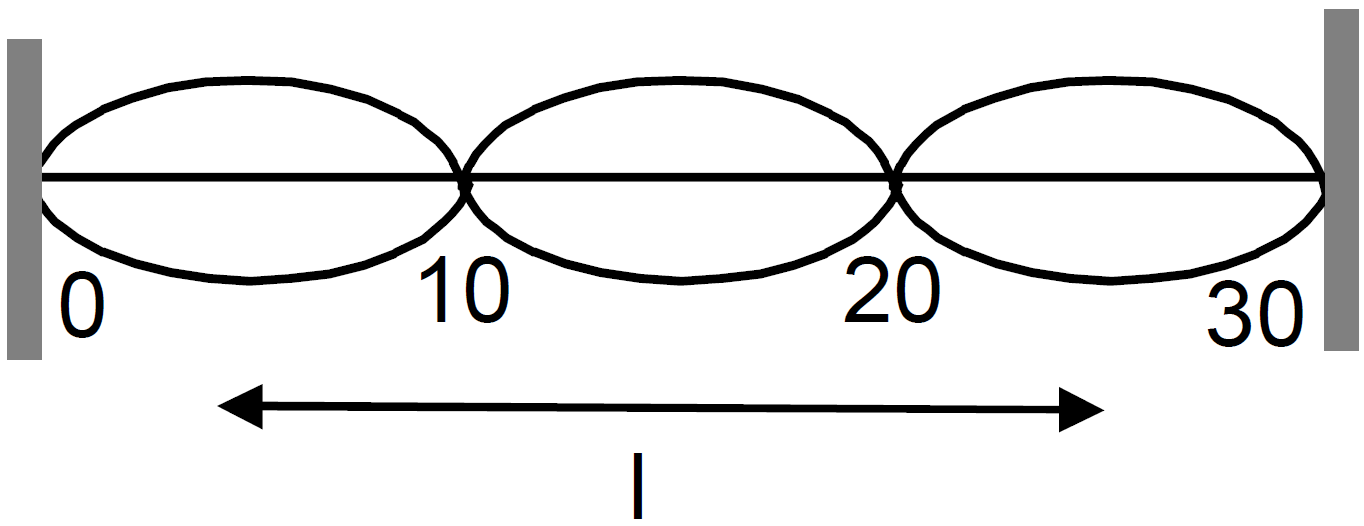
  1. Therefore nodes are located at, $0,\ 10\text{cm},\ 20\text{cm},\ 30\text{cm}$

  2. Length of the string $=\frac{3\lambda}{2}=3\times\frac{20}{2}=30\text{cm}$

  3. $\text{y}=0.4\sin(0.314\text{x})\cos(600\pi\text{t})$

$\Rightarrow0.4\sin\Big\{\big(\frac{\pi}{10}\big)\text{x}\Big\}\cos(600\pi\text{t})$

since $\lambda$ and v are the wavelength and velocity of the waves that interfere to give this vibration $\lambda=20\text{cm}$

$\text{v}=\frac{\omega}{\text{k}}=6000\text{cm/sec}=60\text{m/s}$

Need a full question paper?

Generate a complete, print-ready paper with questions like this in minutes — across 16+ boards, with answer keys.

Start Generating Free

Similar questions

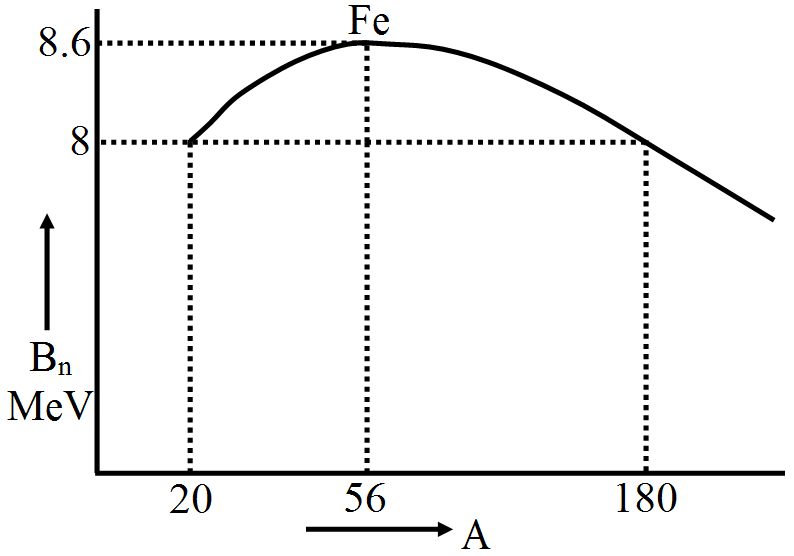
Draw the graph showing the variation of binding energy per nucleon with mass numbers. Give the reason for the decrease of binding energy per nucleon for nuclei with higher mass number.

A compass needle free to turn in a horizontal plane is placed at the centre of circular coil of 30 turns and radius 12 cm. The coil is in a vertical plane making an angle of 45° with the magnetic meridian. When the current in the coil is 0.35 A, the needle points west to east.
  1. Determine the horizontal component of the earth’s magnetic field at the location.
  2. The current in the coil is reversed, and the coil is rotated about its vertical axis by an angle of 90° in the anticlockwise sense looking from above. Predict the direction of the needle. Take the magnetic declination at the places to be zero.
The diameter of the sun is 1.4 × 10⁹m and its distance from the earth is 1.5 × 10¹¹m. Find the radius of the image of the sun formed by a lens of focal length 20cm.
Draw a plot showing the variation of binding energy per nucleon versus the mass number A. Explain with the help of this plot the release of energy in the processes of nuclear fission and fusion.
Define the current sensitivity of a galvanometer. Write its S.I. unit.
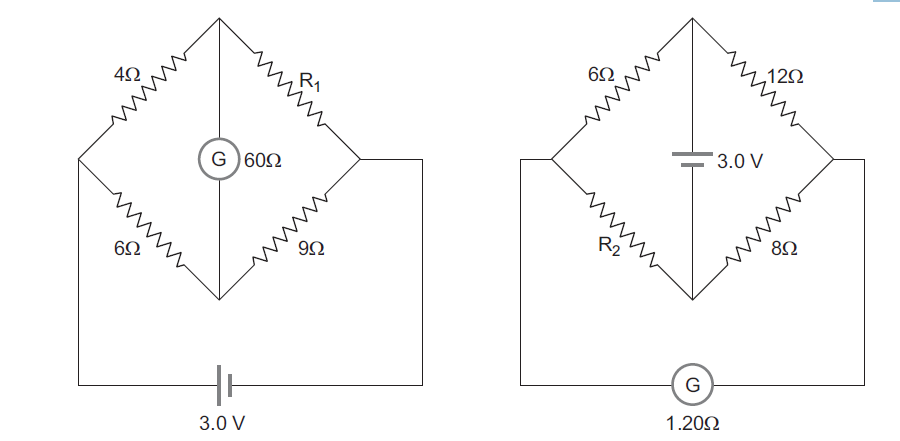
Figure shows two circuits each having a galvanometer and a battery of 3 V. When the galvanometers in each arrangement do not show any deflection, obtain the ratio R/ R2.

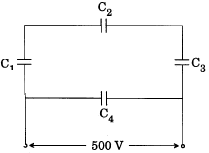
A network of four capacitors each of 12 μF capacitance is connected to a 500 V supply as shown in the figure. Determine (a) equivalent capacitance of the network and (b) charge on each capacitor. 

A block A can slide on a frictionless incline of angle $\theta$ and length l, kept inside an elevator going up with uniform velocity v. Find the time taken by the block to slide down the length of the incline if it is released from the top of the incline.

Figure shows a particle sliding on a frictionless track which terminates in a straight horizontal section. If the particle starts slipping from the point A, how far away from the track will the particle hit the ground?