MCQ
The equation →∑e = ∑IR is applicable to which law?
- AKirchhoff’s second law.
- BKirchhoff’s junction rule.
- CKirchhoff’s third law.
- DNewton’s Law.
Explanation:
The equation →∑e = ∑IR is applicable to Kirchhoff’s second law. This law is also known as Kirchhoff’s loop rule. This expression tells us that in a closed loop, the algebraic sum of the emfs is equal to the algebraic sum of the products of the resistance and currents flowing through them.
Generate a complete, print-ready paper with questions like this in minutes — across 16+ boards, with answer keys.
Which one of the following statements is not correct
|
(a) A diode does not obey Ohm's law |
|
(b) A PN junction diode symbol shows an arrow identifying the direction of current (forward) flow |
|
(c) An ideal diode is an open switch |
|
(d) An ideal diode is an ideal one way conductor |
In Bohr’s model, if the atomic radius of the first orbit is  , then the radius of the fourth orbit is
|
(a) |
(b) 4 |
(c) |
(d) 16 |
The colour of the positive column in a gas discharge tube depends on
|
(a) The type of glass used to construct the tube |
(b) The gas in the tube |
|
(c) The applied voltage |
(d) The material of the cathode |
The image formed by a convex mirror of focal length 30 cm is a quarter of the size of the object. The distance of the object from the mirror is
|
(a) 30 cm |
(b) 90 cm |
(c) 120 cm |
(d) 60 cm |
Two resistances of 400 W and 800 W are connected in series with 6 volt battery of negligible internal resistance. A voltmeter of resistance 10,000 W is used to measure the potential difference across 400 W. The error in the measurement of potential difference in volts approximately is
|
(a) 0.01 |
(b) 0.02 |
(c) 0.03 |
(d) 0.05 |
Two short magnets of equal dipole moments M are fastened perpendicularly at their centre (figure). The magnitude of the magnetic field at a distance d from the centre on the bisector of the right angle is
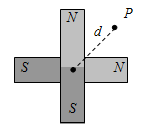
|
(a) |
(b) |
(c) |
(d) |


