MCQ
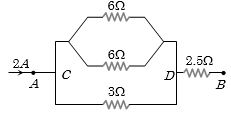
The equivalent resistance and potential difference between $A$ and $B$ for the circuit is respectively
  • $4  \,\Omega$, $8\, V$
  • B
    $8 \,\Omega, \,\,4\, V$
  • C
    $2  \,\Omega$, $2\, V$
  • D
    $16  \,\Omega$, $8\, V$

Answer

Correct option: A.
$4  \,\Omega$, $8\, V$
a
The equivalent resistance between $C$ and $D$ is

$\frac{1}{{R'}} = \frac{1}{6} + \frac{1}{6} + \frac{1}{3} = \frac{2}{3}$ or $R' = \frac{3}{2} = 1.5\,\Omega $

Now the equivalent resistance between $A$ and $B$ as $R' = 1.5\,\Omega $ and $2.5\,\Omega $ are connected in series, so

Now by ohm's law, potential difference between $A$ and $B$ is given by ${V_A} - {V_B} = iR = 2 \times 4.0 = 8\,\,volt$

Need a full question paper?

Generate a complete, print-ready paper with questions like this in minutes — across 16+ boards, with answer keys.
Start Generating Free

Similar questions

When a slow neutron goes sufficiently close to a $\mathrm{U}^{235}$ nucleus, then the process that takes place is
A wire when connected to $220\,V$ mains supply has power dissipation ${P_1}$. Now the wire is cut into two equal pieces which are connected in parallel to the same supply. Power dissipation in this case is ${P_2}$. Then ${P_2}:{P_1}$ is
A wire bent in the shape of a regular $n$-polygonal loop carries a steady current $I$. Let $l$ be the perpendicular distance of a given segment and $R$ be the distance of a vertex both from the centre of the loop. The magnitude of the magnetic field at the centre of the loop is given by
The focal length of a combination of lenses formed with lenses having powers of + 2.50 D and – 3.75 D will be
Quantity that remains unchanged in a transformer is
In one model of the electron, the electron of mass $m_e$ is thought to be a uniformly charged shell of radius $R$ and total charge $e$, whose electrostatic energy $E$ is equivalent to its mass $m_e$ via Einstein's mass energy relation $E=m_e c^2$. In this model, $R$ is approximately $\left(m_e=9.1 \times 10^{-31} \,kg , c=3 \times 10^8 \,ms ^{-1}\right.$, $1 / 4 \pi \varepsilon_0=9 \times 10^9 \,Fm ^{-1}$, magnitude of the electron charge $=1.6 \times 10^{-19} \,C$ )
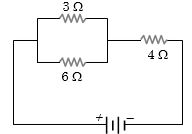
In the figure, current through the $3\,\Omega $ resistor is $0.8\, ampere$, then potential drop through $4\,\Omega $ resistor is ........... $V$
Two charged spheres of radii R, and R2 are connected by a wire. The ratio of the electric fields of the spheres is:
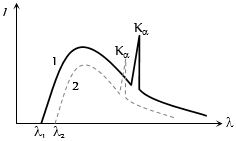
The intensity distribution of $X-$ rays from two coolidge tubes operated on different voltages $V_1$ and $V_2$ and using different target materials of atomic numbers $Z_1$ and $Z_2$ is shown in the figure. Which one of the following inequalities is true?
An electron moving with the speed $5 \times 10^6$ per sec is shooted parallel to the electric field of intensity $1 \times 10^3 \mathrm{~N} / \mathrm{C}$. Field is responsible for the retardation of motion of electron. Now evaluate the distance travelled by the electron before coming to rest for an instant (mass of $e=9 \times 10^{-31} \mathrm{Kg}$. charge = $1.6 \times 10^{-19} \mathrm{C}$)