MCQ
The experiment required to demonstrate the electromagnetic induction was performed by :
  • Faraday
  • B
    Ampere
  • C
    Gauss
  • D
    Micron

Answer

Correct option: A.
Faraday
A

Need a full question paper?

Generate a complete, print-ready paper with questions like this in minutes — across 16+ boards, with answer keys.

Start Generating Free

Similar questions

Capacitance of a parallel plate capacitor becomes 4/3 times its original value if a dielectric slab of thickness t = d/2 is inserted between the plates (d is the separation between the plates). The dielectric constant of the slab is(a) 8 (b) 4(c) 6  (d) 2
       
The wavelength of a photon needed to remove a proton from a nucleus which is bound to the nucleus with $1\ MeV$ energy is nearly:
Direction of force due to magnetic field on a moving charged particle is:
  1. Perpendicular to direction of velocity of charged particle.
  2. Perpendicular to direction of magnetic field.
  3. Parallel to direction of velocity of charged particle.
  4. Parallel to the direction of magnetic field.
Correct statements are.
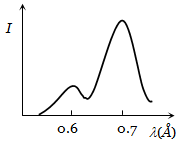
In the diagram a graph between the intensity of $X-$rays emitted by a molybdenum target and the wavelength is shown, when electrons of $30 \ \text{keV}$ are incident on the target. In the graph one peak is of $\mathrm{K}_\alpha$ line and the other peak is of $\mathrm{K}_\alpha$ line and the other peak is of $\mathrm{K}_\beta$ line
The bit rate for a signal, which has a sampling rate of 8 kHz and where 16 quantisation levels have been used is (a) 32000 bits/sec(b) 16000 bits/sec(c) 64000 bits/sec(d) 72000 bits/sec
       
Out of dia, para and ferromagnetism, the universal property of all substances is:
When a metal surface is illuminated by light of wavelengths $400\ nm$ and $250\ nm,$ the maximum velocities of the photoelectrons ejected are $v$ and $2v$ respectively. The work function of the metal is $(h =$ Planck’s constant$, c =$ velocity of light in air$)$
A Young's double slit experiment is performed with white light:
  1. The central fringe will be white.
  2. There will not be a completely dark fringe.
  3. The fringe next to the central will be red.
  4. The fringe next to the central will be violet.
When light propagates in vacuum there is an electric field and a magnetic field. These fields.
The mass number of a nucleus is$:$