MCQ
The expression $x^4 + 4$ can be factorized as:
  • $(x^2 + 2x + 2)(x^2 - 2x + 2)$
  • B
    $(x^2 + 2x + 2)(x^2 + 2x - 2)$
  • C
    $(x^2 - 2x - 2)(x^2- 2x + 2)$
  • D
    $(x^2 + 2)(x^2 - 2)$

Answer

Correct option: A.
$(x^2 + 2x + 2)(x^2 - 2x + 2)$
$x^4 + 4$
$= x^4 + 4 + 4x^2 - 4x^2$
$= (x^4 + 4x^2 + 4) - 4x^2$
$= (x^2 + 2)^2 - (2x)^2$
$= (x^2 + 2 - 2x)(x^2 + 2 + 2x)$
$= (x^2 + 2x + 2)(x^2 - 2x + 2)$
Hence, correct option is $ (a).$

Need a full question paper?

Generate a complete, print-ready paper with questions like this in minutes — across 16+ boards, with answer keys.
Start Generating Free

Similar questions

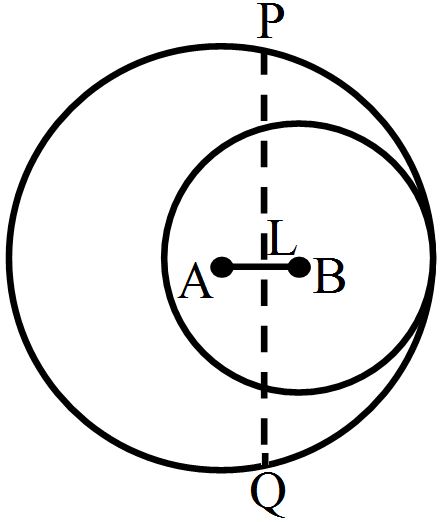
In the adjoining figure, two circles with centres at $A$ and $B$ , and of radii $5\  cm$ and $3\ cm$ touch each other internally. If the perpendicular bisector of $A B$ meets the bigger circle in $P$ and $Q$, find the length of $P Q$.
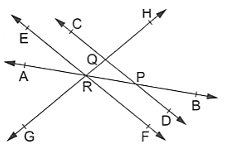
In the adjoining figure, name:
i. Two pairs of intersecting lines and their corresponding points of intersection
ii. Three concurrent lines and their points of intersection
iii. Three rays
iv. Two line segments
Image
If $p(x) = 5 - 4x + 2x^2$, find:
$i. p(0)$
$ii. p(3)$
$iii. p(-2)$
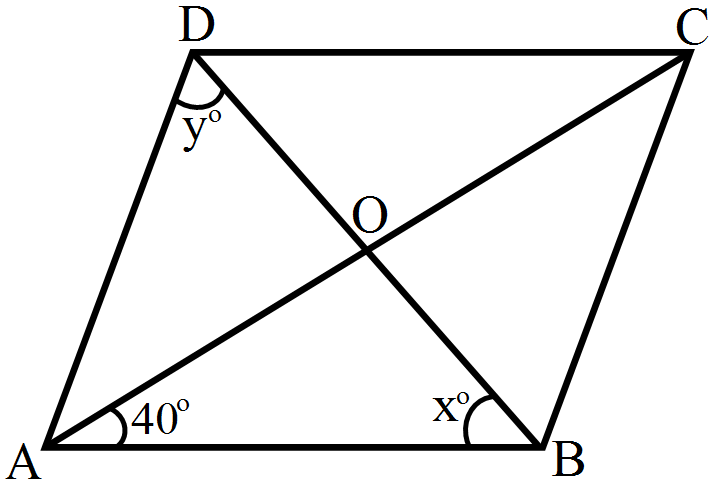
In each of the figures given below, $ABCD$ is a rhombus. Find the value of $x$ and $y$ in each case.
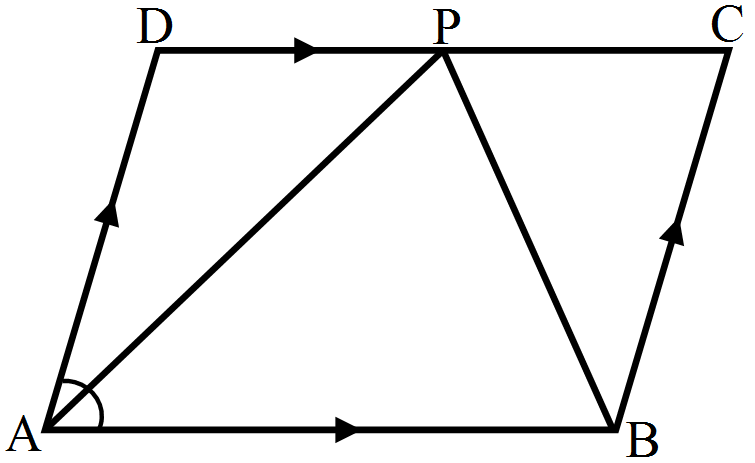
In the adjoining figure, $\text{ABCD}$ is a parallelogram in which $\angle\text{A}=60^{\circ}.$ If the bisectors of $\angle\text{A}$ and $\angle\text{B}$ meet $DC$ at $P$, prove that
$i. \angle\text{APB}=90^{\circ},$
$ii. AD = DP$ and $PB = PC = BC$,
$iii. DC = 2AD$.
Find the values of $a$ and $b$ if $\frac{7+3 \sqrt{5}}{3+\sqrt{5}}-\frac{7-3 \sqrt{5}}{3-\sqrt{5}}=a+b \sqrt{5}$.
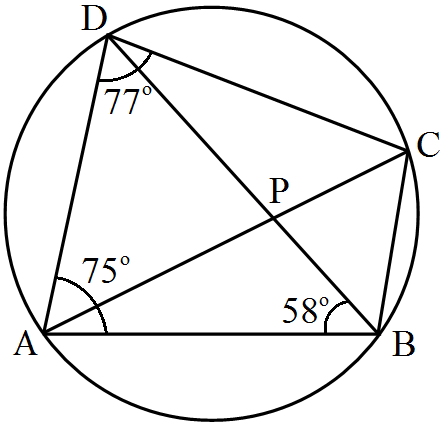
In the given figure, $ABCD$ is a cyclic quadrilateral in which $\angle\text{BAD} = 75^\circ,\ \angle\text{ABD} = 58^\circ$ and $\angle\text{ADC} = 77^\circ, AC$ and $BD$ intersect at $P.$ Then, find $\angle\text{DPC}.$
Find the missing frequencies in the follwoing frequency distribution whose mean is $34.$
$x$
$10$
$20$
$30$
$40$
$50$
$60$
Total
$f$
$4$
$f_1$​​​​​​​
$8$
$f_2​​​​​​​$
$3$
$4$
$35$
The difference between inside and outside surfaces of a cylindrical tube $14\ cm$ long, is $88\ cm^2.$ If the volume of the tube is $176\ cm^3$, find the inner and outer radii of the tube.
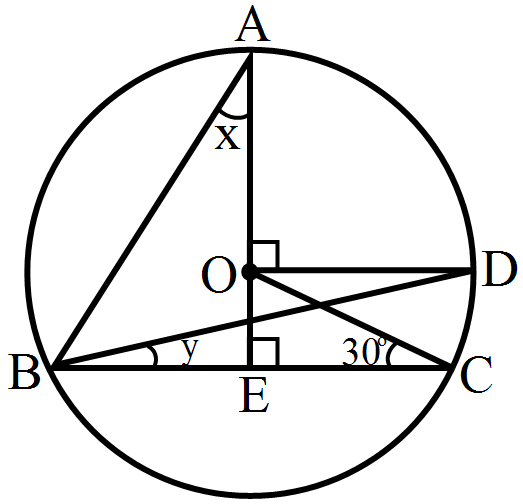
In the given figure, $O$ is the centre of the circle and $\angle\text{BCO}=30^\circ.$ Find $x$ and $y$.