MCQ
The factors of $a^2 - 1 - 2x - x^2$ are:
  • A
    $(a - x + 1)(a - x - 1)$
  • B
    $(a + x - 1)(a - x + 1)$
  • C
    $(a + x +1)(a - x + 1)$
  • None of these.

Answer

Correct option: D.
None of these.
$a^2 - 1 - 2x - x^2$
$= a^2 - (1 + 2x + x^2)$
$= a^2 - (1 + x)^2$
$= [a - (1 + x)][a + (1 + x)]$
$= (a - x - 1)(a + x + 1)$

Need a full question paper?

Generate a complete, print-ready paper with questions like this in minutes — across 16+ boards, with answer keys.
Start Generating Free

Similar questions

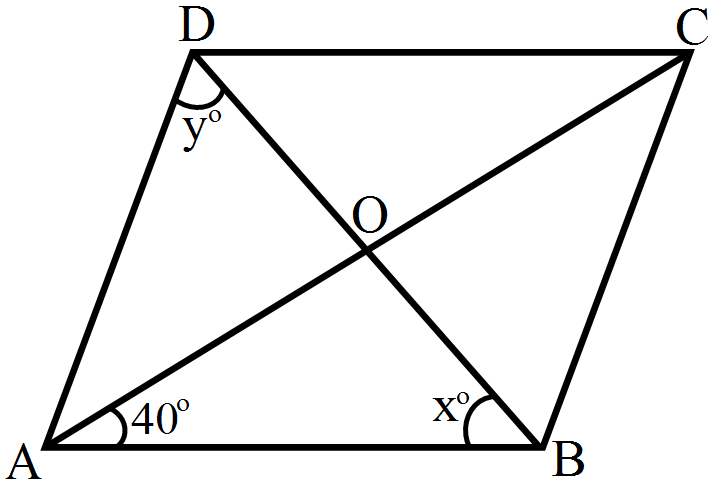
In each of the figures given below, ABCD is a rhombus. Find the value of x and y in each case.
If the mean of the following data is $20.2,$ find the value of $p.$
Variable $(x_i)$
$10$ $15$ $20$ $25$ $30$
Frequency $(f_i)$
$6$ $8$ $p$ $10$ $6$
If $2$ and $0$ are the zeros of the polynomial $f(x) = 2x^3 - 5x^2 + ax + b$ then find the values of $a$ and $b.$
Hint: $f(x) = 0$ and $f(0) = 0.$
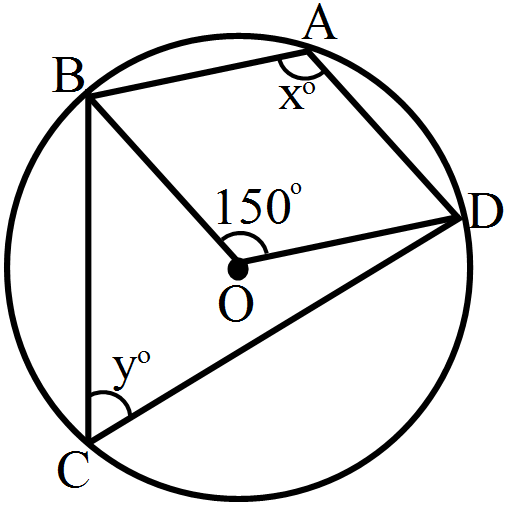
In the given figure, O is the centre of a circle and $\angle\text{BOD}=150^\circ.$ Find the values of x and y.
If two lines intersect, prove that the vertically opposite angles are equal.
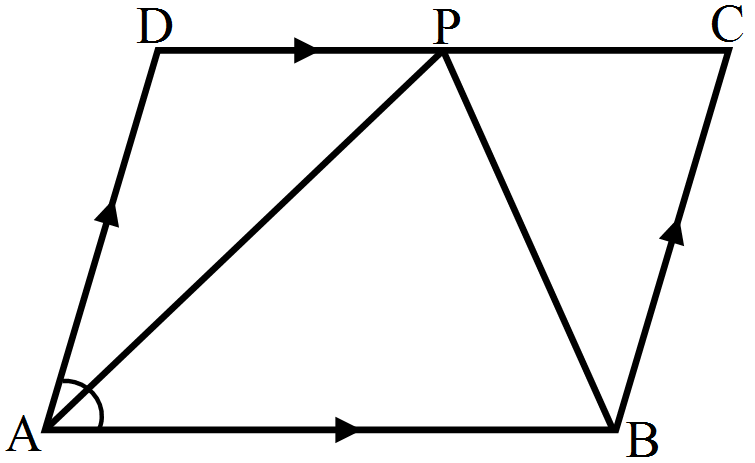
In the adjoining figure, ABCD is a parallelogram in which $\angle\text{A}=60^{\circ}.$ If the bisectors of $\angle\text{A}$ and $\angle\text{B}$ meet DC at P, prove that
  1. $\angle\text{APB}=90^{\circ},$
  2. AD = DP and PB = PC = BC,
  3. DC = 2AD.
​​​​​​​
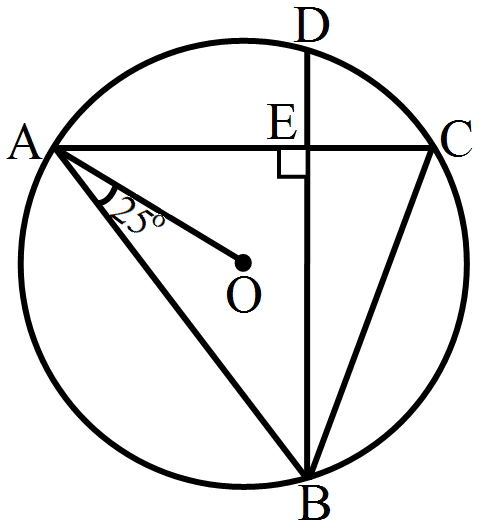
In the adjoining figure, chords AC and BD of a circle with centre O, intersect at right angles at E. If $\angle\text{OAB}=25^\circ,$ calculate $\angle\text{EBC}.$
Draw the graph of the equation, 2x + y = 6.
Find the coordinates of the point where the graph cuts the x-axis.
Draw a histogram to represent the following information:
Class interval
5-10
10-15
15-25
25-45
45-75
Frequency
6
12
10
8
18
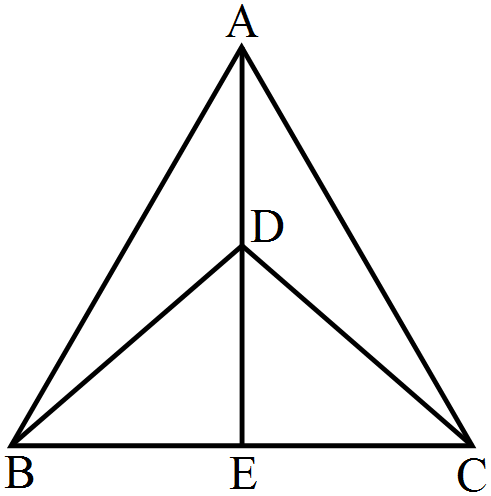
$\triangle\text{ABC}$ and $\triangle\text{DBC}$ are two isosceles triangles on the same base BC and vertices A and D are on the same side of BC. If AD is extended to intersect BC at E, show that:
  1. $\triangle\text{ABD}\cong \triangle\text{ACD}$
  2. $\triangle\text{ABE}\cong\triangle\text{ACE}$
  3. AE bisects $\angle\text{A}$ as well as $\angle\text{D}$
  4. AE is the perpendicular bisector of BC.