MCQ
The feasible region corresponding to the linear constraints of a Linear Programming Problem is given belowImage
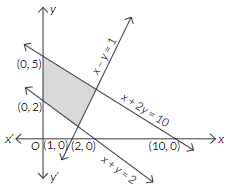
Which of the following is not a constraint to the given Linear Programming Problem?
  • A
    $x+y \geq 2$
  • B
    $x+2 y \leq 10$
  • C
    $x-y \geq 1$
  • D
    $x-y \leq 1$

Answer

We observe, $(0,0)$ does not satisfy the inequality
$x-y \geq 1$
So, the half plane represented by the above inequality will not contain origin therefore, it will not contain the shaded feasible region.

Need a full question paper?

Generate a complete, print-ready paper with questions like this in minutes — across 16+ boards, with answer keys.

Start Generating Free

Similar questions

Suppose the solution of the differential equation $\frac{d y}{d x}=\frac{(2+\alpha) x-\beta y+2}{\beta x-2 \alpha y-(\beta \gamma-4 \alpha)} \quad$ represents a circle passing through origin. Then the radius of this circle is :
If $x = \sin t$ and $y = \sin pt$, then the value of $\left( {1 - {x^2}} \right){{{d^2}y} \over {d{x^2}}} - x{{dy} \over {dx}} + {p^2}y$ is equal to
If the sum of all the solutions of $\tan ^{-1}\left(\frac{2 x}{1-x^2}\right)+\cot ^{-1}\left(\frac{1-x^2}{2 x}\right)=\frac{\pi}{3}$ $-1 < x < 1,x \neq 0,$ is $\alpha-\frac{4}{\sqrt{3}}$, then $\alpha$ is equal to $..........$.
The direction ratios of the line x - y + z - 5 = 0 = x - 3y - 6 are proportional to:

  1. $3,1,-2$

  2. $2,-4,1$

  3. $\frac{3}{\sqrt{14}},\frac{1}{\sqrt{14}},\frac{-2}{\sqrt{14}}$

  4. $\frac{2}{\sqrt{41}},\frac{-4}{\sqrt{41}},\frac{1}{\sqrt{41}}$

For $0 \le x \le \pi ,$ the area bounded by $y = x$ and $y = x + \sin x,$ is
The length of the perpendicular drawn from the point (4, -7, 3) on the y-axis is:
If $\mathrm{A}$ and $\mathrm{B}$ are two events such that $\mathrm{P}(\mathrm{A}) \neq 0$ and $\mathrm{P}(\mathrm{B} | \mathrm{A})=1,$ then.
If $y = b\cos \log {\left( {{x \over n}} \right)^n}$, then ${{dy} \over {dx}} = $
If $f(x) = \left| {\begin{array}{*{20}{c}}1&x&{x + 1}\\{2x}&{x(x - 1)}&{(x + 1)x}\\{3x(x - 1)}&{x(x - 1)(x - 2)}&{(x + 1)x(x - 1)}\end{array}} \right|$ then $f(100)$ is equal to
The Polygon Law of Vector Addition is simply an extension of ____________?
  1. Parallelogram Law of Vector Addition
  2. Triangular Law of Vector Addition
  3. Both A and B
  4. None of the above