MCQ
The field of view is maximum for
  • A
    Plane mirror
  • B
    Concave mirror
  • Convex mirror
  • D
    Cylindrical mirror

Answer

Correct option: C.
Convex mirror
c
(c) since, the convex mirror diverges the ray of light and hence it can collect rays from wider field of view.

Hence, field of view is maximum for Convex mirror.

Need a full question paper?

Generate a complete, print-ready paper with questions like this in minutes — across 16+ boards, with answer keys.
Start Generating Free

Similar questions

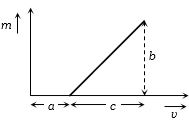
The graph shows how the magnification $m$ produced by a convex thin lens varies with image distance $v$. What was the focal length of the used
The counting rate observed from a radioactive source at t = 0 second was 1600 counts per second and at t = 8 seconds it was 100 counts per second. The counting rate observed, as counts per second at t = 6 seconds, will be
The $X-Y$ plane be taken as the boundary between two transparent media $M _{1}$ and $M _{2} . M _{1}$ in $Z \geq 0$ has a refractive index of $\sqrt{2}$ and $M _{2}$ with $Z <0$ has a refractive index of $\sqrt{3}$. A ray of light travelling in $M_{1}$ along the direction given by the vector $\overrightarrow{ A }=4 \sqrt{3 i }-3 \sqrt{3 \hat{j}}-5 \hat{ k }$, is incident on the plane of separation. The value of difference between the angle of incident in $M _{1}$ and the angle of refraction in $M _{2}$ will be $....$ degree.
To deposit one litre of hydrogen at 22.4 atmosphere from acidulaled water, the quantity of electricity that must pass through is
A particle of charge q and mass m is moving along the x -axis with a velocity v and enters a region of electric field E and magnetic field B as shown in figure below for which figure the net force on the charge may be zero
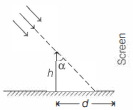
A long horizontal mirror is next to a vertical screen (seen figure). Parallel light rays are falling on the mirror at an angle $\alpha$ from the vertical. If a vertical object of height $h$ is kept on the mirror at a distance $(d > h) \tan \alpha$. The length of the shadow of the object on the screen would be
The output of $OR$ gate is $1:$
The refractive index of a converging lens is $1.4.$ What will be the focal length of this lens if it is placed in a medium of same refractive index ? (Assume the radii of curvature of the faces of lens are $R _{1}$ and $R _{2}$ respectively)
The electrostatic potential due to an electric dipole is directly proportional to:
The inductance of a solenoid $0.5 m$ long of cross$-$sectional area $20\ cm^2$ and with $500$ turns is