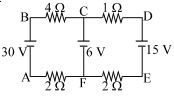
The figure shows a network of four resistances and three batteries Mark the incorrect statement.
Diffcult
Download our app for free and get started
Apply Kirchhoffs law$:$
For left loop $BCFAB,$ $4 I_{1}+2 I_{1}=30-6$ or $6 I_{1}=24 \Rightarrow I_{1}=4 A$
In this equation on $I_{2}$ term so the current flowing in the left loop is independent of the right loop.
For right loop $DCFED,$ $1 I_{2}+2 I_{2}=15-6$ or $3 I_{2}=9 \Rightarrow I_{2}=3 A$
Here also no $I_{1}$ term so The current flowing in the right loop is independent of the left loop.
Net current in through $6 \mathrm{V}$ battery is: $I=I_{1}+I_{2}=4+3=7 \mathrm{A}$
Thus, the $6 \mathrm{V}$ battery is getting charged. Both $15 \mathrm{V}$ and $30 \mathrm{V}$ batteries produce current in $6 V$ battery.

Download our appand get started for free
Experience the future of education. Simply download our apps or reach out to us for more information. Let's shape the future of learning together!No signup needed.*
Similar Questions
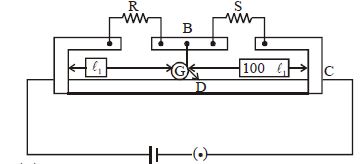
- 1In a meter bridge the point $D$ is neutral point as shown in the figure.View Solution
- 2A cell of negligible resistance and $e.m.f.$ $2$ $volts$ is connected to series combination of $2$, $3$ and $5\, ohm$. The potential difference in volts between the terminals of $3\, ohm$ resistance will beView Solution
- 3When a resistance of $2\, ohm$ is connected across the terminals of a cell, the current is $0.5\, A$. When the resistance is increased to $5\, ohm$, the current is $0.25\, A$. The $e.m.f.$ of the cell is ................. $V$View Solution
- 4A copper rod of cross-sectional area $A$ carries a uniform current $I$ through it. At temperature $T$, if the volume charge density of the rod is $\rho $, how long will the charges take to travel a distance $d$ ?View Solution
- 5A $2\, W$ carbon resistor is color coded with green, black, red and brown respectively. The maximum current which can be passed through this resistor is .............. $mA$View Solution
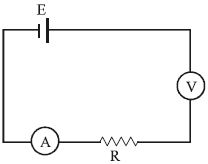
- 6Assertion : All electric devices shown in the circuit are ideal. The reading of each of ammeter $(a)$ and voltmeter $(V)$ is zero.View Solution
Reason : An ideal voltmeter draws almost no current due to very large resistance, and hence $(V)$ and $(a)$ will read zero.
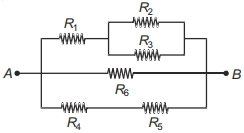
- 7View SolutionConsider the combination of resistors as shown in figure and pick out the correct statement
- 8An electric bulb rated $50 \mathrm{~W}-200 \mathrm{~V}$ is connected across a $100 \mathrm{~V}$ supply. The power dissipation of the bulb is :View Solution
- 9A galvanometer together with an unknown resistance in series is connected to two identical batteries each of $1.5\, V$. When the batteries are connected in series, the galvanometer records a current of $1\,A$, and when batteries are in parallel the current is $0.6\,A$. What is the internal resistance of the battery ?View Solution
- 10Two wires $A$ and $B$ made of same material and having their lengths in the ratio $6 : 1$ are connected in series. The potential difference across the wires are $3\,V$ and $2\,V$ respectively. If $r_A$ and $r_B$ are the radii of $A$ and $B$ respectively, then $\frac{{{r_B}}}{{{r_A}}}$ isView Solution