A cell of negligible resistance and $e.m.f.$ $2$ $volts$ is connected to series combination of $2$, $3$ and $5\, ohm$. The potential difference in volts between the terminals of $3\, ohm$ resistance will be
Medium
Download our app for free and get started
Current supplied by cell $i = \frac{2}{{2 + 3 + 5}} = \frac{1}{5}\,A$
So potential difference across $3$ will be $V = \frac{{3 \times 1}}{5} = 0.6\,V$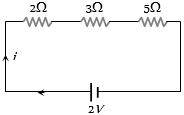

Download our appand get started for free
Experience the future of education. Simply download our apps or reach out to us for more information. Let's shape the future of learning together!No signup needed.*
Similar Questions
- 1View SolutionWhich of the following is vector quantity
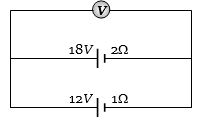
- 2Two batteries, one of emf $18\,volts\;emf$ and internal resistance $2\,\Omega $ and the other of emf $12\, volt$ and internal resistance $1\,\Omega $, are connected as shown. The voltmeter $V$ will record a reading of .............. $volt$View Solution
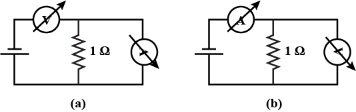
- 3View SolutionIn the circuit as shown in figure the
- 4A carbon resistor has colour strips as violet, yellow brown and golden. The resistance is .............. $\Omega$View Solution
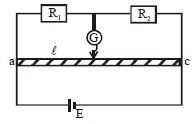
- 5Fig. shows rough sketch of meter bridge. $(G)$ deflects zero at length $\ell \, cm$. Now $R_1$ and $R_2$ are interchanged then balancing length increases by $25\, cm$. Find $R_1/R_2$View Solution
- 6Two resistors of $6\,\Omega $ and $9\,\Omega $ are connected in series to a $120\, volt$ source. The power consumed by the $6\,\Omega $ resistor is ........... $W$View Solution
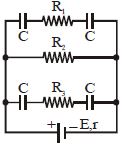
- 7In the circuit diagram of figure, $E = 5\, volt, r = 1\, \Omega ,$$ R_2 = 4\, \Omega , R_1 = R_3 = 1 \Omega$ and $C = 3\, μF.$ Then the magnitude of the charge on each capacitor plate is......$\mu C$View Solution
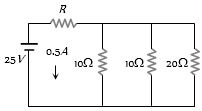
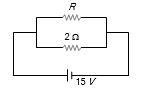
- 8If in the circuit, power dissipation is $150\, W$, then $R$ is ............... $\Omega$View Solution
- 9In a potentiometer experiment two cells of $e.m.f.$ $E_1$ and $E_2$ are used in series and in conjunction and the balancing length is found to be $58\, cm$ of the wire. If the polarity of $E_2$ is reversed, then the balancing length becomes $29\, cm$. The ratio $\frac{{{E_1}}}{{{E_2}}}$ of the $e.m.f.$ of the two cells isView Solution
- 10A student uses the resistance of a known resistor $(1 \,\Omega)$ to calibrate a voltmeter and an ammeter using the circuits shown below. The student measures the ratio of the voltage to current to be $1 \times 10^3 \,\Omega$ in circuit $(a)$ and $0.999 \,\Omega$ in circuit $(b)$. From these measurements, the resistance (in $\Omega$ ) of the voltmeter and ammeter are found to be close toView Solution