Question
The first (IE) and second (IER) ionization enthalpy: $\left( KJ mol ^{-1}\right)$ of three elements $A , B$ and C are given below:
 ABC
$IE _1$4035491142
$IE _2$264010602080
Identify the element which is likely to be
i. a non-metal
ii. an alkali metal
iii. an alkaline earth metal
Answer

i. C is non-metal
ii. A is alkali metal
iii.B is alkaline earth metal

Need a full question paper?

Generate a complete, print-ready paper with questions like this in minutes — across 16+ boards, with answer keys.

Start Generating Free

Similar questions

What is the concentration of sugar $\left(\mathrm{C}_{12} \mathrm{H}_{22} \mathrm{O}_{11}\right) \mathrm{i} \mathrm{~mol} \mathrm{~L}^{-1}$ if its 20 g are dissolved in enough water to make a final volume up to 2 L ?
A nonmetallic element of group 13, used in making bullet proof vests is extremely hard solid of black colour. It can exist in many allotropic forms and has unusually high melting point. Its trifluoride acts as Lewis acid towards ammonia. The element exihibits maximum covalency of four. Identify the element and write the reaction of its trifluoride with ammonia. Explain why does the trifluoride act as a Lewis acid.
Choose the correct answer.$\Delta\text{U}^\ominus$of combustion of methane is $-\mathrm{X} \mathrm{~kJ} \mathrm{~mol}^{-1}$. The value of $\Delta\text{H}^\ominus$ is:
What happen when electricity is passed in aqueous solution of sodium acetate?### Explain Kolbe's electrolysis for formation of alkanes.
For following reaction calculate change in standard free energy change :
$
C_2 H_2(g)+2 H_2(g) \rightarrow C_2 H_6(g)
$
For $C _2 H _2(g)$ and $C _2 H _6(g)$ value of $\Delta G _{ f }{ }^0$ is 209.2 $kJ mol ^{-1}$ and $-32.9 kJ mol ^{-1}$ respectively.
For the following compound, write structural formulas and IUPAC names for all possible isomers having the number of double or triple bond as indicated:
$\mathrm{C}_5 \mathrm{H}_8$(one triple bond).
$A 2.0L$ container at $25^\circC$ contain $1.25$ moles of $O_2$ and 3.2 moles of $C.$
  1. What is the initial pressure in the flask?
  2. If the carbon and oxygen react as completely as possible to form $CO$, what will be the final pressure in the container?
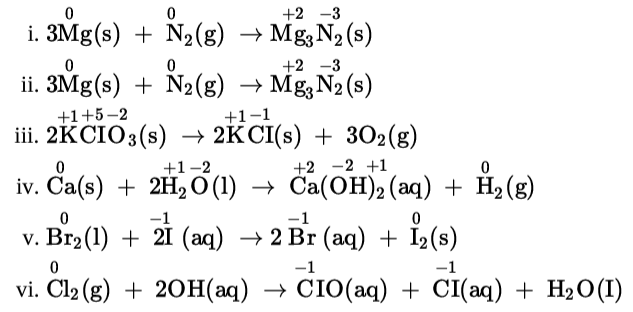
Identify the type of redox reaction taking place in the following.
Image
Melting point, enthalpy of vapourisation and viscosity data of $H_2O$ and $D_2O$ are given below:
 
$H_2O$
$D_2O$
Melting point / K
373.0
374.4
Enthalpy of vapourisation at $(373 K)/ kJ mol^{-1}$
40.66
41.61
Viscosity/ centipoise
0.8903
1.107
On the basis of this data, explain in which of these liquids intermolecular forces are stronger?
  1. Give one example of position isomerism.
  2. What are electrophiles? Give one example of electrophilic substitution reaction.
  3. Write the chemistry of Lassaigne's test for qualitative analysis of nitrogen.