Sample QuestionsModel Paper 6 questions
One sample from each question group in this chapter. Select any group above to see the full set with answer keys.
Answer: D.
View full solution →The enthalpy change of a chemical reaction $\Delta_r H$ equals ( $a_i$ and $b_i$ are stoichiometric coefficients)?
- A
$\sum_i a_i H_{\text {products }} \pm \sum_i b_i H_{\text {reactants }}$
- B
$\sum_i a_i H_{\text {products }}+\sum_i b_i H_{\text {reactants }}$
- C
$\sum_i a_i H_{\text {products }}$
- ✓
$\sum_i a_i H_{\text {products }}-\sum_i b_i H_{\text {reactants }}$
Answer: D.
View full solution →Eka-aluminium is known as _____________ .
Answer: D.
View full solution →Addition of cold conc. $H _2 SO _4$ with alkenes is an example of
- A
nucleophilic addition reaction
- B
electrophilic substitution reaction
- ✓
electrophilic addition reaction
- D
nucleophilic substitution reaction
Answer: C.
View full solution →$CH _3- MgBr$ and $\left( C _2 H _5\right)_2 CuLi$ are _____________ .
- A
- B
- C
- D
both electrophiles and nucleophiles
View full solution →Assertion (A): Law of conservation of mass hold good for nuclear reaction.
Reason (R): Law states that mass can be neither created nor destroyed in a chemical reaction.
- A
Both A and R are true and R is the correct explanation of A.
- B
Both A and R are true but R is not the correct explanation of A.
- C
A is true but R is false.
- ✓
A is false but R is true.
Answer: D.
View full solution →Assertion (A): Splitting of the spectral lines in the presence of a magnetic field is known as the Stark effect.
Reason (R): The line spectrum is simplest for the hydrogen atoms.
- A
Both A and R are true and R is the correct explanation of A.
- B
Both A and R are true but R is not the correct explanation of A.
- C
A is true but R is false.
- ✓
A is false but R is true.
Answer: D.
View full solution →Assertion (A): Both cyclopropane and propene give addition reactions readily.
Reason (R): Cyclopropane and propene are isomers of each other.
- A
Both A and R are true and R is the correct explanation of A.
- ✓
Both A and R are true but R is not the correct explanation of A.
- C
A is true but R is false.
- D
A is false but R is true.
Answer: B.
View full solution →Assertion (A): Each carbon in ethylene molecule is $sp ^2$ hybridised.
Reason (R): The H-C-H bond angle in ethylene molecule is $120^{\circ}$.
- A
Both A and R are true and R is the correct explanation of A.
- ✓
Both A and R are true but R is not the correct explanation of A.
- C
A is true but R is false.
- D
A is false but R is true.
Answer: B.
View full solution →Among the following pairs of orbitals which orbital will experience the larger effective nuclear charge?
1. 2 s and 3 s
2. 4 d and 4 f
3. 3 p and 3 f.
What do you understated by Resonance energy?
Which of the following compounds will show cis-trans isomerism?
1. $\left( CH _3\right)_2 C = CH - C _2 H _5$
2. $CH _2= CBr _2$
3. $C _6 H _5 CH = CH - CH _3$
4. $CH _3 CH = CCl CH { }_3$
View full solution →How many significant figures should be present in the answer of the following calculations?
1. $\frac{0.02856 \times 298.15 \times 0.112}{0.5785}$
2. $5 \times 5.364$
3. $0.0125+0.7864+0.0215$
View full solution →How does electronegativity and non - metallic character related to each other?
10 mL of $H _2$ combine with 5 mL of $O _2$ to form water. When 200 mL of $H _2$ at STP is passed over heated CuO , the CuO loses 0.144 g of its weight. Does the above data correspond to the law of constant composition?
View full solution →The first (IE) and second (IER) ionization enthalpy: $\left( KJ mol ^{-1}\right)$ of three elements $A , B$ and C are given below:| | A | B | C |
| $IE _1$ | 403 | 549 | 1142 |
| $IE _2$ | 2640 | 1060 | 2080 |
Identify the element which is likely to be
i. a non-metal
ii. an alkali metal
iii. an alkaline earth metal View full solution →Lifetimes of the molecules in the excited states are often measured by using pulsed radiation source of duration nearly in the nano second range. If the radiation source has the duration of 2 ns and the number of photons emitted during the pulse source is $2.5 \times 10^{15}$, calculate the energy of the source.
View full solution →Which of the following species, do not show a disproportionation reaction and why?
$ClO ^{-}, ClO _2^{-}, ClO _3^{-}$and $ClO _4^{-}$
Also, write the reaction for each of the species that disproportionate.
View full solution →For the reaction, $2 A( g )+ B ( g ) \longrightarrow 2 D ( g ) ; \Delta U^o=-10.5 kJ$ and $\Delta S^o=-44.1 JK ^{-1}$. Calculate $\Delta G^o$ for the reaction and predict whether the reaction may occur spontaneously. $\left( R =8.314 \times 10^{-3} kJ K ^{-1} mol^{-1}, T=298 K\right)$
View full solution →In order to explain the characteristic geometrical shapes of polyatomic molecules, Pauling introduced the concept of hybridisation. The orbitals undergoing hybridisation should have nearly the same energy. There are various type of hybridisations involving s, p and d-type of orbitals. The type of hybridisation gives the characteristic shape of the molecule or ion.
1. Why all the orbitals in a set of hybridised orbitals have the same shape and energy?
2. Out of $XeF _2$ and $SF _2$ which molecule has the same shape as $NO _2^{+}$ion?
3. Out of $XeF _4$ and $XeF _2$ which molecule doesn't have the same type of hybridisation as P (Phosphorus) has in $PF _5$ ?
OR
Unsaturated compounds undergo additional reactions. Why?
View full solution →The existing large number of organic compounds and their ever-increasing numbers has made it necessary to classify them on the basis of their structures. Organic compounds are broadly classified as open-chain compounds which are also called aliphatic compounds. Aliphatic compounds further classified as homocyclic and heterocyclic compounds. Aromatic compounds are special types of compounds. Alicyclic compounds, aromatic compounds may also have heteroatom in the ring. Such compounds are called heterocyclic aromatic compounds. Organic compounds can also be classified on the basis of functional groups, into families or homologous series. The members of a homologous series can be represented by general molecular formula and the successive members differ from each other in a molecular formula by a $- CH _2$ unit.
1. The successive members of a homologous series differ by which mass of amu? (1)
2. Does Pyridine, pyrrole, thiophene are all heteroaromatic compounds (1)
3. Difference between heterocyclic and homocyclic compound. (2)
OR
Is tetrahydrofuran is aromatic compounds? (2)
View full solution →1. Will $CCl _4$ give a white precipitate of AgCl on heating it with $AgNO _3$ ?
2. Identify the functional groups present in the following compounds.
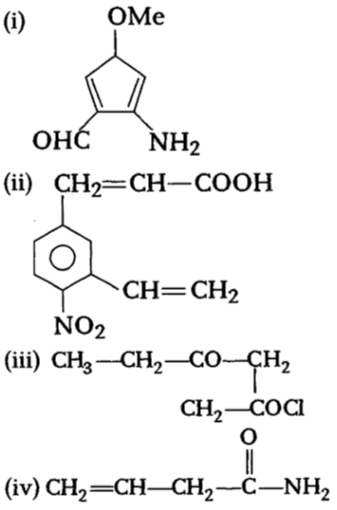
View full solution →1. During estimation of nitrogen present in an organic compound by Kjeldahl's method, the ammonia evolved from 0.5 g of the compound in Kjeldahl's estimation of nitrogen, neutralized 10 mL of $1 M H _2 SO _4$. Find out the percentage of nitrogen in the compound.
2. Explain why $\left( CH _3\right)_3 \stackrel{+}{ C }$ is more stable than $CH _3 \stackrel{+}{ C } H _2$ and $\stackrel{+}{ C } H _3$ is the least stable cation.
View full solution →What is the pH of 0.001 M aniline solution? The ionisation constant of aniline is $4.27 \times 10^{-10}$. Calculate the degree of ionisation of aniline in the solution. Also calculate the ionisation constant of the conjugate acid of aniline.
View full solution →Ethyl acetate is formed by the reaction of ethanol and acetic acid and the equilibrium is represented as:
$
CH_3 COOH(l)+C_5 H_5 OH(l) \rightleftharpoons CH_3 COOC_2 H_5(l)+H_2 O(l)
$
a. Write the concentration ratio (reaction quotient), $Q _{ C }$, for this reaction (note: water is not in excess and is not a solvent in this reaction)
b. At 293 K , if one starts with 1.00 mol of acetic acid and 0.18 mol of ethanol, there is 0.171 mol of ethyl acetate in the final equilibrium mixture. Calculate the equilibrium constant.
c. Starting with 0.5 mol of ethanol and 1.0 mol of acetic acid and maintaining it at $293 K, 0.214$ mol of ethyl acetate is found after some time. Has equilibrium been reached?
View full solution →Attempt any five of the following:
1. What is electrophile in sulphonation?
2. Write IUPAC name of following:
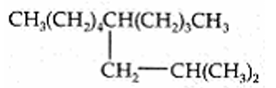
3. Write IUPAC name: $CH _3 CH - C \left( CH _3\right)_2$
4. Methane does not react with chlorine in dark. Why?
5. How would you convert ethene to ethane molecule?
6. What is Huckel rule?
7. What is decarboxylation? Give an example. View full solution →