MCQ
The following cannot be explained by wave nature of light:
  • A
    Interference
  • Photo electric effect
  • C
    Diffraction
  • D
    Refraction

Answer

Correct option: B.
Photo electric effect
According to wave physics energy of a wave depends upon an amplitude of a wave it means that there light of any frequency can make electrons come out from metal but it did not happen, light of certain fixed frequency can make electron come out from metal. So the photoelectric effect can only be explained by particle nature of light not wave.

Need a full question paper?

Generate a complete, print-ready paper with questions like this in minutes — across 16+ boards, with answer keys.
Start Generating Free

Similar questions

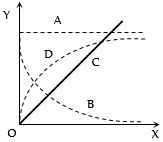
In Fig. $X$ represents time and $Y$ represent activity of a radioactive sample. Then the activity of sample, varies with time according to the curve
Two identical parallel plate capacitors are connected in series to a battery of $100\,V$. A dielectric slab of dielectric constant $4.0$ is inserted between the plates of second capacitor. The potential difference across the capacitors will now be respectively
A metallic ring with a small cut is held horizontally and a magnet is allowed to fall  vertically through the ring then the acceleration of the metallic ring is :
When a ferromagnetic material is heated to temperature above its Curie temperature, the material
In $p-$type semiconductors, holes are:
After passing through a polariser a linearly polarised light of intensity $I$ is incident on an analyser making an angle of $30^{\circ}$ with that of the polariser. The intensity of light emitted from the analyser will be
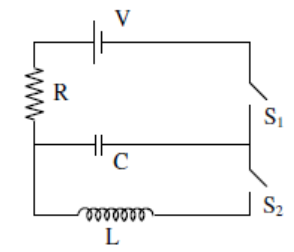
In an $LCR$ circuit as shown below both switches are open initially. Now switch $S_1$ is closed, $S_2$ kept open. $( q$ is charge on the capacitor and $\tau= RC$ is capacitive time constant$)$. Which of the following statement is correct?
Image
A straight wire of length ($\pi^2$) metre is carrying a current of 2A and the magnetic field due to it is measured at a point distant 1 cm from it. If the wire is to be bent into a circle and is to carry the same current as before, the ratio of the magnetic field at its centre to that obtained in the first case would be
A magnetic field
The electric potential $V$ at any point $O$ ($x$, $y$, $z$ all in metres) in space is given by $V = 4{x^2}\,volt$. The electric field at the point $(1m,\,0,\,2m)$ in $volt/metre$ is