MCQ
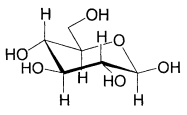
The following carbohydrate is
  • A
    a ketohexose
  • an aldohexose
  • C
    an $\alpha$-furanose
  • D
    an $\alpha$-pyranose

Answer

Correct option: B.
an aldohexose
b
It is a $\beta$-pyranose (since $OH$ group is above at anomeric carbon) hence, it is an aldohexose.

If one of the group on anomeric carbon is $- CH _2 OH$ then it is ketohexose.

Option $B$ is correct.

Need a full question paper?

Generate a complete, print-ready paper with questions like this in minutes — across 16+ boards, with answer keys.
Start Generating Free

Similar questions

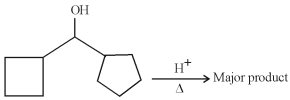
In the above reaction. Left hand side and right hand side rings are named as ' $A$ ' and ' $B$ ' respectively. They undergo ring expansion. The correct statement for this process is:
Which $d-$ block element is expected to have highest enthalpy of atomisation, among the following ?
$Xe{F_4}$  Processing strongly with water gives .......
When $FeCl_3$ reacts with $K_4[Fe(CN)_6]$ then which of the following compound is formed
$p$-Amino- $N, N$-dimethylaniline is added to a strongly acidic solution of ${X}$. The resulting solution is treated with a few drops of aqueous solution of ${Y}$ to yield blue coloration due to the formation of methylene blue. Treatment of the aqueous solution of ${Y}$ with the reagent potassium hexacyanoferrate$(II)$ leads to the formation of an intense blue precipitate. The precipitate dissolves on excess addition of the reagent. Similarly, treatment of the solution of ${Y}$ with the solution of potassium hexacyanoferrate$(III)$ leads to a brown coloration due to the formation of ${Z}$.

$1.$ The compound ${X}$ is

$(A)$ $\mathrm{NaNO}_3$ $(B)$ $\mathrm{NaCl}$ $(C)$ $\mathrm{Na}_2 \mathrm{SO}_4$ $(D)$ $\mathrm{Na}_2 \mathrm{~S}$

$2.$ The compound ${Y}$ is

$(A)$ $\mathrm{MgCl}_2$ $(B)$ $\mathrm{FeCl}_2$ $(C)$ $\mathrm{FeCl}_3$ $(D)$ $\mathrm{ZnCl}_2$

$3.$ The compound ${Z}$ is

$(A)$ $\left.\mathrm{Mg}_2 \mid \mathrm{Fe}(\mathrm{CN})_6\right]$ $(B)$ $\operatorname{Fe}\left[\mathrm{Fe}(\mathrm{CN})_6\right]$

$(C)$ $\mathrm{Fe}_4\left[\mathrm{Fe}(\mathrm{CN})_6\right]_3$ $(D)$ $\mathrm{K}_2 \mathrm{Zn}_3\left[\mathrm{Fe}(\mathrm{CN})_6\right]_2$

Give the answer question $1,2$ and $3.$
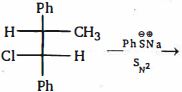
Principal organic product of the reaction will be
Correct order of bond angle for bond will be 
The number of oxygen atoms bonded to one phosphorous atom in $P_4O_6$ is
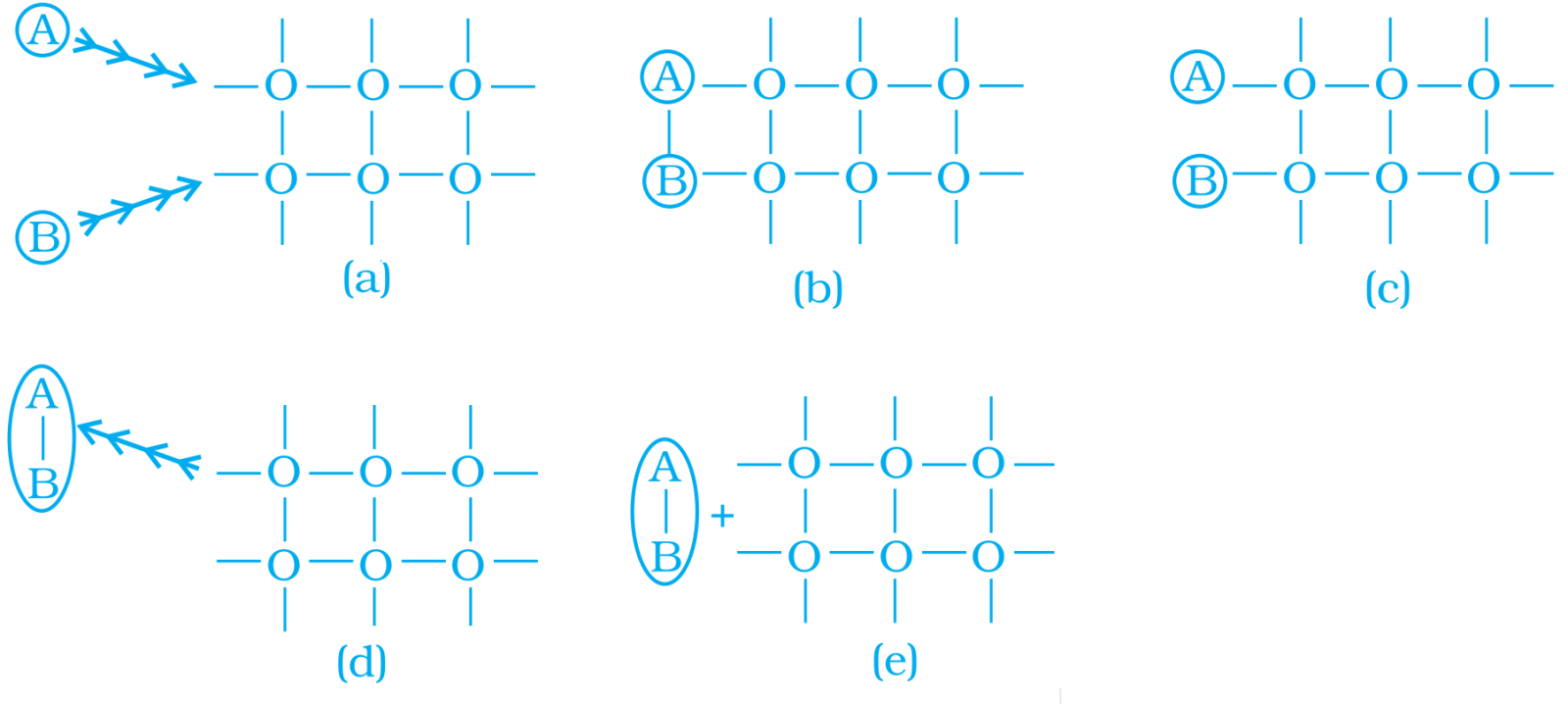
Arrange the following diagrams in correct sequence of steps involved in the mechanism of catalysis, in accordance with modern adsorption theory.
The reaction
$
\frac{1}{2} H_{2(g)}+AgCl_{(aq)} \rightleftharpoons H_{(aq)}^{+}+Cl_{(aq)}^{-}+Ag_{(s)}
$ takes place in a galvanic cell. Its correct representation is :