Question
The function$\text{f(x)}=1+|\cos\text{x}|$ is:
  1. Continuous no where.
  2. Continuous everywhere.
  3. Not differentiable at x = 0
  4. Not differentiable at $\text{x}=\text{n}\pi,\text{n}\in\text{Z}.$

Answer

  1. Continuous everywhere.

Solution:

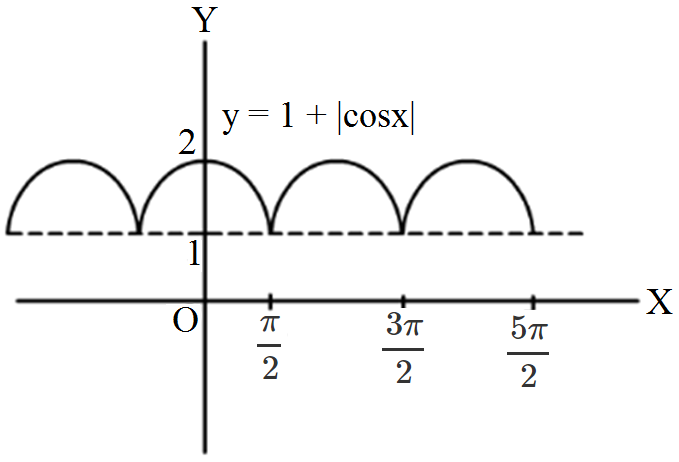
Graph of the function $\text{f(x)}=1+|\cos\text{x}|$ is as show blow:

From the graph, we can see that f(x) is everywhere continuous but not differentiable at $\text{x}=(2\text{n}+1)\frac{\pi}{2},\text{n}\in\text{Z}.$

Need a full question paper?

Generate a complete, print-ready paper with questions like this in minutes — across 16+ boards, with answer keys.

Start Generating Free

Similar questions

At which points the function$f(x) = \frac{x}{{[x]}}$, where$[.]$ is greatest integer function, is discontinuous
$\int {\left( {\sin \left( {101x} \right).{{\sin }^{99}}x} \right)} dx = \frac{{\sin \left( {100x} \right){{\left( {\sin x} \right)}^\lambda }}}{\mu } + C$ where $C$ is constant of integration then $\frac{\lambda }{\mu }$ is equal to
Let $\text{f(x)}=\begin{cases}1, & \text{x}\leq-1\\|\text{x}|, & -1 <\text{x} <1\\0,&\text{x}\geq1\end{cases}$ then, f is:
  1. Continuous at x = -1
  2. Differentible at x = -1
  3. Everywhere continuous.
  4. Everywhere diffrentiable.
If x > 1, then $2\tan^{-1}\text{x}+\sin^{-1}\Big(\frac{2\text{x}}{1+\text{x}^2}\Big)$ is equal to:
  1. $4\tan^{-1}\text{x}$
  2. $0$
  3. $\frac{\pi}{2}$
  4. $\pi$
The total cost of the train to travel $500 km$ at the most economical speed is
Let $\Omega$ be the set of all $3 \times 3$ symmetric matrices all of whose entries are either $0$ or $1$ . Five of these entries are $1$ and four of them are $0$ .

$1.$ The number of matrices in $\Omega$ is

$(A)$ $12$ $(B)$ $6$ $(C)$ $9$ $(D)$ $3$

$2.$ The number of matrices $A$ in $\Omega$ for which the system of linear equations

$A\left[\begin{array}{l}x \\ y \\ z\end{array}\right]=\left[\begin{array}{l}1 \\ 0 \\ 0\end{array}\right]$ has a unique solution, is

$(A)$ less than $4$

$(B)$ at least $4$ but less than $7$

$(C)$ at least $7$ but less than $10$

$(D)$ at least $10$

$3.$ The number of matrices $A$ in $\Omega$ for which the system of linear equations

$A\left[\begin{array}{l}x \\ y \\ z\end{array}\right]=\left[\begin{array}{l}1 \\ 0 \\ 0\end{array}\right]$ is inconsistent, is

$(A)$ $0$ $(B)$ more than $2$ $(C)$ $2$ $(D)$ $1$
If $a, b, c $ are position vector of vertices of a triangle $ABC$, then unit vector perpendicular to its plane is
Choose the correct answer in exercise:
$\int\frac{\text{x dx}}{(\text{x}-1)(\text{x}-2)}$ equals
  1. $\text{log}\Bigg|\frac{(\text{x}-1)^2}{\text{x}-2}\Bigg|+\text{C}$
  2. $\text{log}\Bigg|\frac{(\text{x}-2)^2}{\text{x}-1}\Bigg|+\text{C}$
  3. $\text{log}\Bigg|\Bigg(\frac{\text{x}-1}{\text{x}-2}\Bigg)^2\Bigg|+\text{C}$
  4. $\text{log}|(\text{x}-1)(\text{x}-2)|+\text{c}$
The number of real values of $x$ satisfying $\left| {\,\begin{array}{*{20}{c}} x&{3x + 2}&{2x - 1}\\{2x - 1}&{4x}&{3x + 1}\\{7x - 2}&{17x + 6}&{12x - 1}\end{array}\,} \right|$ $= 0$ is
Let $\overrightarrow{ a }=\alpha \hat{ i }+2 \hat{ j }-\hat{ k }$ and $\overrightarrow{ b }=-2 \hat{ i }+\alpha \hat{ j }+\hat{ k }$, where $\alpha \in R$. If the area of the parallelogram whose adjacent sides are represented by the vectors $\vec{a}$ and $\vec{b}$ is $\sqrt{15\left(\alpha^{2}+4\right)}$, then the value of $2|\vec{a}|^{2}+(\vec{a} \cdot \vec{b})|\vec{b}|^{2}$ is equal to