Question
The game of billiards is played with balls placed on a rectangular table. One ball is struck with the
end of a stick, called a cue. The ball bounces into other balls and relects off the sides of the table. In a real game, the ball may spin, but for mathematical purposes, it is considered that the ball travels in a straight line with the same relection and incidence angles.
Image

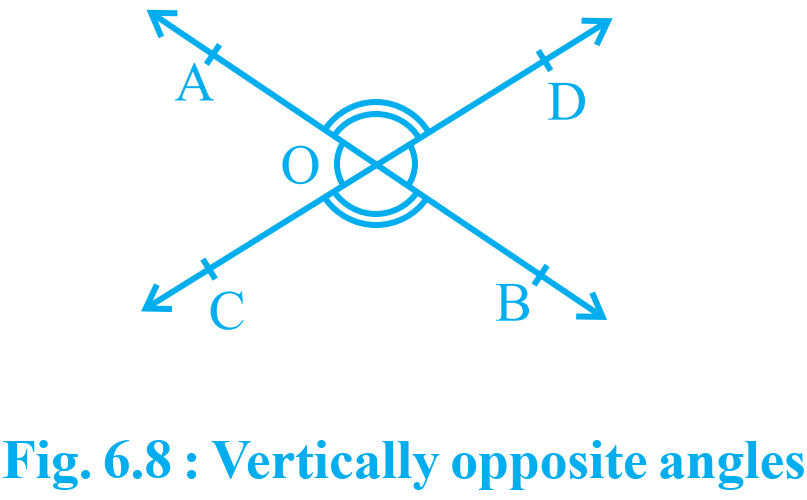
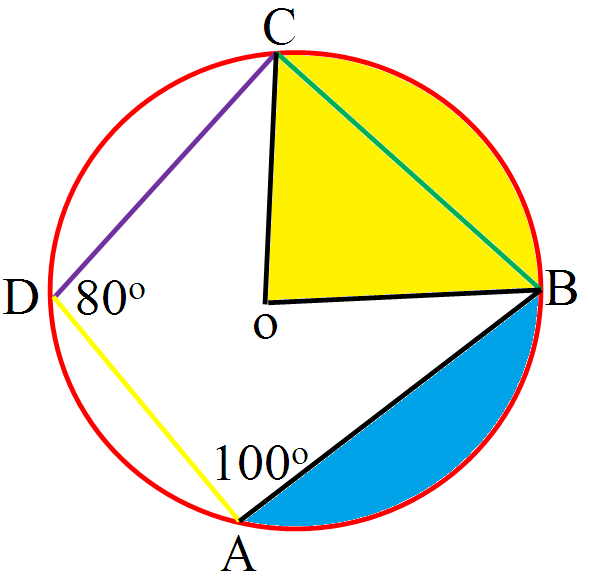
On a billiard table ABCD, the ball placed at O is struck with the cue.
1. What is the value of ∠a + ∠d?
2. Why is the line OM parallel to PN?
Answer

1. 90
   90°
2. Mathematically valid proof
● Let angles on line AMB be a, x and b and angles on line BNC be c, y and d.
x = 180 – (a + b) …..1
y = 180 – (c + d) …...2
 Adding 1 and 2,
x + y = 360 – (a + b + c + d)
  = 360 – (2a + 2c)
  = 360 – 2 × 90 = 180
Thus, lines OM and NP are parallel. 

Need a full question paper?

Generate a complete, print-ready paper with questions like this in minutes — across 16+ boards, with answer keys.

Start Generating Free

Similar questions

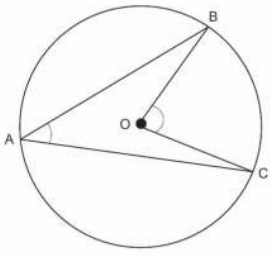
Given below is the igure of a circle with centre O.
The measure of ∠BOC = 88°.

Image
9. What is the measure of ∠BAC?
  A. 44°
  B. 60°
  C. 88°
  D. 176°
10. Priya claims, “The length of OB is equal to the length of OC.”
Siya and Aditi provide different justiications for Priya’s claim. 
Siya says, “OB and OC are radii of the same circle.” 
Aditi says, “OC is the base of ∠BOC.”
Who has given the correct justiication for Priya’s claim?

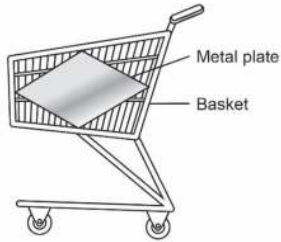
The figure below shows the side view of a shopping trolley. The metal plate is fixed on the side by the store keeper for advertisement. 

Image
6. Three angles of the basket are obtuse. Which type of angle is the fourth?
  A. Acute
  B. Obtuse
  C. Right
  D. Relex
7. What is the shape of the metal plate?
  A. Square
  B. ectangle
  C. Rhombus
  D. Parallelogram

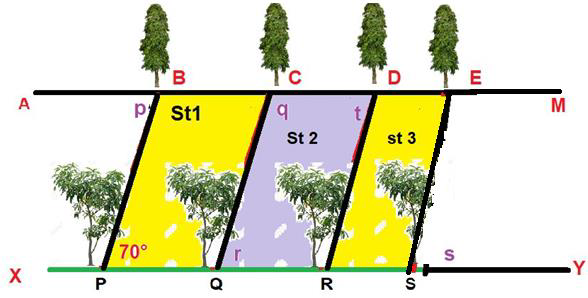
Read the Source/ Text given below and answer any four questions: There were two parallel roads $AM$ and $XY$ in New Delhi. Due to increasing pollution, $\text{MCD}$ planned to get planted trees on these roads. On the road $AM,$ plants of Ashoka were planted by one company. While on the road $XY$ mango trees were planted by another company.

Between these roads three streets $St_1, St_2$ and $St_3$ were situated. During the survey, $\angle\text{BPQ}$ was measured to be $70^\circ$ and other angles $\text{p, q, r, s}$ and t were also measured. Now answer the following questions:
  1. What is the measure of $\angle\text{p}?$
  1. $60^\circ$
  2. $70^\circ$
  3. $160^\circ$
  4. $100^\circ$
  1. What is the measure of $\angle\text{q}?$
  1. $60^\circ$
  2. $70^\circ$
  3. $160^\circ$
  4. $110^\circ$
  1. What is the value of $\frac{\text{p}+\text{q}+\text{t}}{5}?$
  1. $50^\circ$
  2. $70^\circ$
  3. $160^\circ$
  4. $100^\circ$
  1. What is the measure of $\angle\text{EsY}?$
  1. $60^\circ$
  2. $140^\circ$
  3. $70^\circ$
  4. $110^\circ$
  1. What is value of ${4p - (q + r) - (r - s)}$?
  1. $50^\circ$
  2. $100^\circ$
  3. $160^\circ$
  4. $180^\circ$
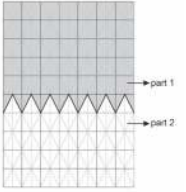
Glass buildings can be strengthened using iron frames. A glass structure and its iron frame are
shown below.

Image
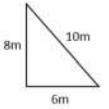
The frame consists of equal triangles. The dimensions of a triangle are shown below.

Image
1. How much area is enclosed by one triangle?
2. What is the area of part 1 of the frame?
  A. 84 m²
  B. 1680 m²
  C. 3360 m²
  D. 3696 m²
3. Is the area of part 1 equal to the area of part 2? Why?
4. Maintenance of the building’s exterior is done by a company. The company charges Rs 750 per square meter per month.
Which of the following calculations represents the monthly maintenance charges?
  A. 24 × 12
  B. 750 × 24
  C. 3024 × 750
  D. 6720 × 750

Read the Source/ Text given below and answer these questions:
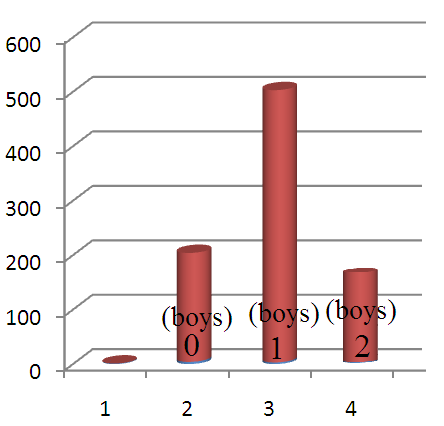
In a healthcare survey by the state government of Maharashtra to study the malnutritional problems in children, 1000 families with 2 children were selected randomly from a town and the following data were recorded:


If a family is chosen at random.
  1. The probability that is no boy:
  1. $-\frac{6}{25}$
  2. $\frac{6}{25}$
  3. $0$
  4. $\frac{3}{5}$
  1. The probability that it has one boy:
  1. $\frac{14}{25}$
  2. $\frac{16}{25}$
  3. $1$
  4. $\frac{6}{25}$
  1. The probability that it has 2 boys:
  1. $\frac35$
  2. $\frac45$
  3. $\frac15$
  4. $\frac{3}{5}$
  1. The probability that it has at least one boy:
  1. $\frac{16}{25}$
  2. $\frac{14}{25}$
  3. $\frac{6}{25}$
  4. $\frac{19}{25}$
  1. The probability that it has at most 1 boy:
  1. $\frac45$
  2. $\frac65$
  3. $\frac15$
  4. $\frac15$
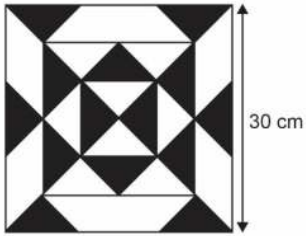
The design on a tile is made of isosceles triangles. 
The side lengths of the triangles are 6 cm, 6 cm and 8 cm. 

Image
5. How much area of the tile is black?
  A. 24 cm²
  B. 9√7 cm²
  C. 90 cm²
  D. 112√5 cm²
6. A tile is made by joining the vertices of four equilateral triangles. The side length of the triangles is 15 cm. What is the area of the tile? 

Read the Source/ Text given below and answer these questions:

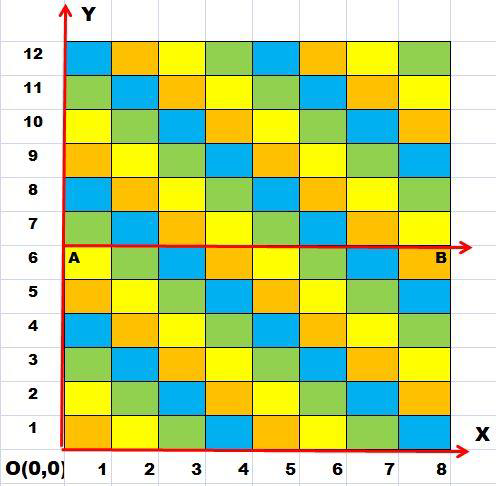
Roshan decorated one of his bathroom wall with tiles as shown in the picture. He was having tiles of four colours orange, yellow, green and blue. He fitted the tiles in $8$ columns and $12$ rows. The size of one tile was $1$foot $\times 1$ foot and the area of each tile is $1$ foot$^2$. He arranged the tile in such a way that colour of tiles in each row and column were in the pattern: Orange $\rightarrow$ Yellow $\rightarrow$ green $\rightarrow$ Blue $\rightarrow$ Orange $\rightarrow .....$ and so on. Now answer the following questions:
  1. Which colour tile was fitted at the point with coordinates $(5, 3)$?
  1. Orange.
  2. Yellow.
  3. Green.
  4. Blue.
  1. Which colour tile was fitted at the point with coordinates $(7, 7)$?
  1. Orange.
  2. Yellow.
  3. Green.
  4. Blue.
  1. Which colour tile was fitted at the point with coordinate $(2, 5)$?
  1. Orange.
  2. Yellow.
  3. Green.
  4. Blue.
  1. What is the area of the tiles fitted in the rectangular part $\text{OABX}$?
  1. $50$ foot$^2$
  2. $24$ foot$^2$
  3. $12$ foot$^2$
  4. $48$ foot$^2$
  1. What is the ordinate of top row tiles?
  1. $8$
  2. $12$
  3. $16$
  4. $6$
Read the passage given below and answer these questions:
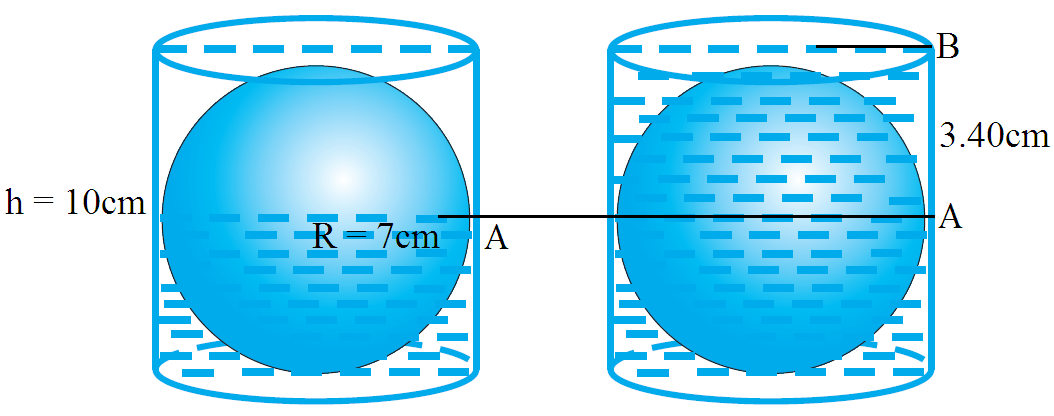
Dev was doing an experiment to find the radius r of a sphere. For this he took a cylindrical container with radius $R = 7\ cm$ and height $10\ cm.$ He filled the container almost half by water as shown in the left figure. Now he dropped the yellow sphere in the container. Now he observed as shown in the right figure the water level in the container raised from $A$ to $B$ equal to $3.40\ cm.$​​​​​​​
  1. What is the approximate radius of the sphere?
  1. $7\ cm$
  2. $5\ cm$
  3. $4\ cm$
  4. $3\ cm$
  1. What is the volume of the cylinder?
  1. $700\ cm^3$
  2. $500\ cm^3$
  3. $1540\ cm^3$
  4. $2000\ cm^3$
  1. What is the volume of the sphere?
  1. $700\ cm^3$
  2. $600\ cm^3$
  3. $500\ cm^3$
  4. $523.8\ cm^3$
  1. How many litres water can be filled in the full container? $($ Take $1$ litre $= 1000\ cm^3):$
  1. $1.50$
  2. $1.44$
  3. $1.54$
  4. $2$
  1. What is the surface area of the sphere?
  1. $314.3\ m^2$
  2. $300\ m^2$
  3. $400\ m^2$
  4. $350\ m^2$