Question types
Lines and Angles question types
342 questions across 9 question groups — pick any mix to generate a MATHS paper with step-by-step answer keys.
342
Questions
9
Question groups
5
Question types
01
M.C.Q
229 Q→02Assertion (A) & Reason (B) MCQ
57 Q→03True False[1 Marks ]
9 Q→04Fill In The Blanks[1 Marks ]
12 Q→051 Marks Question
3 Q→062 Marks Questions
11 Q→073 Marks Question
5 Q→085 Marks Questions
3 Q→09Case study (4 Marks)
13 Q→Sample Questions
Lines and Angles questions
One sample from each question group in this chapter. Select any group above to see the full set with answer keys.
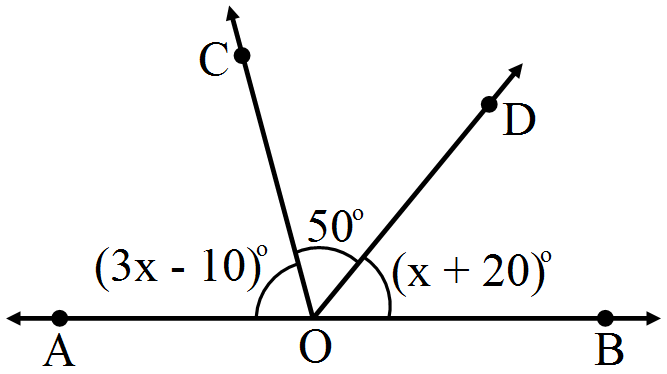
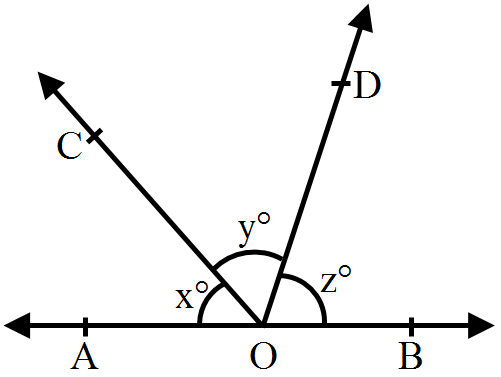
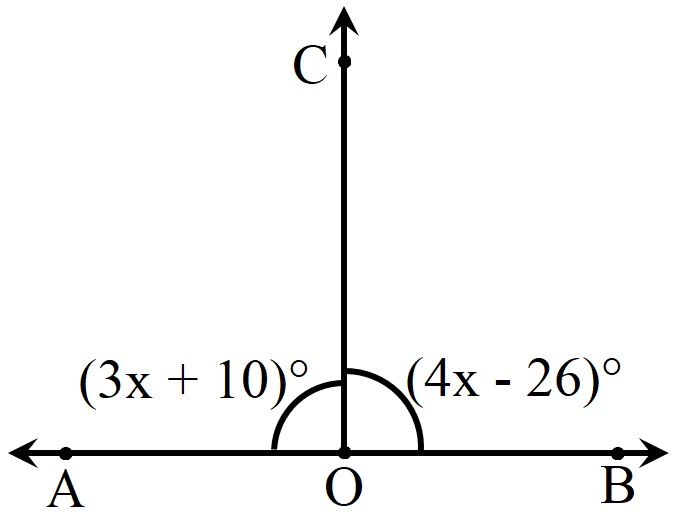
In the adjoining figure, $AOB$ is a straight line. If $x : y : z = 4 : 5 : 6,$ then $y =$?
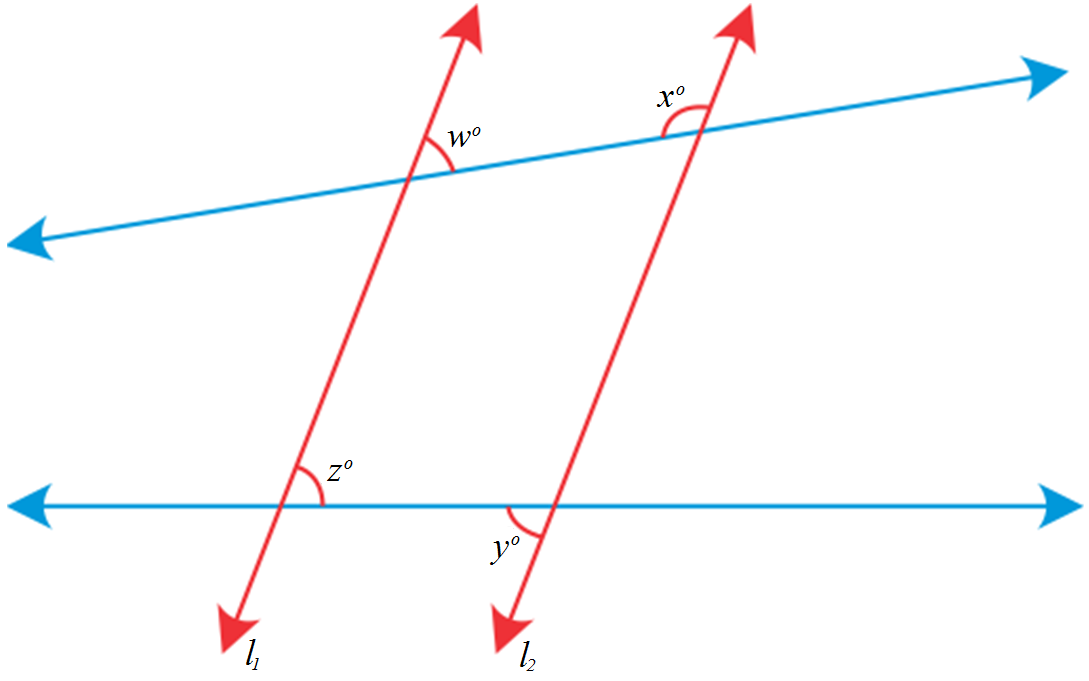
View full solution →In figure, if $l_1|| l_2,$ what is $x + y$ in terms of $w$ and $z$?
View full solution →Directions: In the following questions, the Assertions (A) and Reason(s) (R) have been put forward. Read both the statements carefully and choose the correct alternative from the following:
Assertion: A triangle can have tow obtuse angles.
Reason: Sum of the three angles in a triangle is always 180°.
Assertion: A triangle can have tow obtuse angles.
Reason: Sum of the three angles in a triangle is always 180°.
- Both assertion and reason are true and reason is the correct explanation of assertion.
- Both assertion and reason are true but reason is not the correct explanation of assertion.
- Assertion is true but reason is false.
- Assertion is false but reason is true.
Directions: In the following questions, the Assertions (A) and Reason(s) (R) have been put forward. Read both the statements carefully and choose the correct alternative from the following:
Assertion: The angles of a triangle are in the ratio 2 : 3 : 4. The largest angle of the triangle is 80°.
Reason: The sum of all the interior angles of a triangle is 180°.
Assertion: The angles of a triangle are in the ratio 2 : 3 : 4. The largest angle of the triangle is 80°.
Reason: The sum of all the interior angles of a triangle is 180°.
- Both Assertion and Reason are correct and Reason is the correct explanation for Assertion.
- Both Assertion and Reason are correct and Reason is not the correct explanation for Assertion.
- Assertion is true but the reason is false.
- Both assertion and reason are false.
Directions: In the following questions, the Assertions (A) and Reason(s) (R) have been put forward. Read both the statements carefully and choose the correct alternative from the following:
Assertion: If the inclination between the arms is less than a right angle, it is called an acute angle.
Reason: 134° is type of acute angle.
Assertion: If the inclination between the arms is less than a right angle, it is called an acute angle.
Reason: 134° is type of acute angle.
- Both Assertion and Reason are correct and Reason is the correct explanation for Assertion.
- Both Assertion and Reason are correct and Reason is not the correct explanation for Assertion.
- Assertion is true but the reason is false.
- Both assertion and reason are false.
Directions: In the following questions, the Assertions (A) and Reason(s) (R) have been put forward. Read both the statements carefully and choose the correct alternative from the following:
Assertion: 183° is a type of reflex angle.
Reason: A reflex angle is smaller than straight angle.
Assertion: 183° is a type of reflex angle.
Reason: A reflex angle is smaller than straight angle.
- Both Assertion and Reason are correct and Reason is the correct explanation for Assertion.
- Both Assertion and Reason are correct and Reason is not the correct explanation for Assertion.
- Assertion is true but the reason is false.
- Both assertion and reason are false.
The following statements are true (T) and which are false (F)?
If angles forming a linear pair are equal, then each of these angles is of measure 90°.
If angles forming a linear pair are equal, then each of these angles is of measure 90°.
The following statements are true (T) and which are false (F)?
Angles forming a linear pair are supplementary.
Angles forming a linear pair are supplementary.
The following statements are true (T) and which are false (F)? Give reasons.
If two parallel lines are intersected by a transversal, then the interior angles on the same side of the transversal are equal.
If two parallel lines are intersected by a transversal, then the interior angles on the same side of the transversal are equal.
The following statements are true (T) and which are false (F)?
Angles forming a linear pair can both be acute angles.
Angles forming a linear pair can both be acute angles.
The following statements are true (T) and which are false (F)? Give reasons.
If two parallel lines are intersected by a transversal, then alternate interior angles are equal.
If two parallel lines are intersected by a transversal, then alternate interior angles are equal.
If a transversal intersects a pair of lines in such a way that the sum of interior angles on the same side of transversal is 180°. Then the lines are _____ .
If the sum of two adjacent angles is 180°, then the _____ arms of the two angles are opposite rays.
The complement of an acute angle is _______ .
If two parallel lines are intersected by a transversal, then interior angles on the same side of the transversal are _______.
Two lines parallel to the same line are __________ to each other.
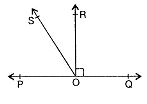
In the figure, $POQ$ is a line. Ray $OR$ is perpendicular to line $PQ. OS$ is another ray lying between rays $OP$ and $OR.$ Prove that $\angle ROS={1\over2}(\angle QOS-\angle POS)$
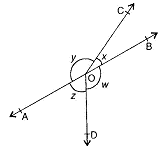
View full solution →In figure, if $x + y = w + z,$ then prove that $AOB$ is a line.
View full solution →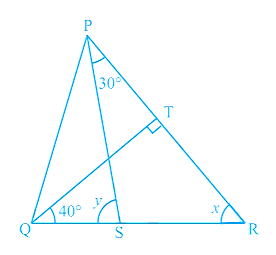
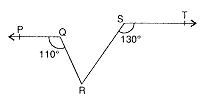
In figure, if $PQ \ || \ ST, \angle PQR = 110^ \circ$ and $\angle RST = 130 ^\circ.$ Find $\angle QRS.$
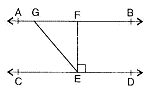
View full solution → In figure, if $AB \ || \ CD, EF ⊥ CD$ and $\angle GED = 126^\circ.$ Find $\angle AGE, \angle GEF$ and $\angle FGE.$
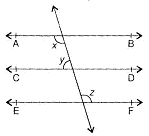
View full solution →In figure, if $AB \ || \ CD, CD \ || \ EF$ and $y : z = 3 : 7,$ find $x.$
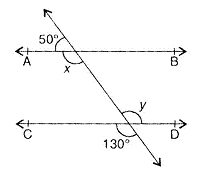
View full solution → In figure, find the values of $x$ and $y$ and then show that $AB \ || \ CD.$
View full solution → If the $\angle XYZ = {64^\circ }$ and $XY$ is produced to point $P.$ Draw a figure from the given information. If ray $YQ$ bisects $\angle ZYP, $ find $\angle XYQ$ and reflex $\angle QYP.$
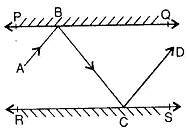
View full solution →In figure, PQ and RS are two mirrors placed parallel to each other. An incident ray AB strikes the mirror PQ at B. The reflected ray moves along the path BC and strikes the mirror RS at C and again reflects back along CD. Prove that AB || CD.
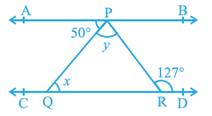
In the given figure, if AB || CD, $\angle$ APQ = 50° and $\angle$PRD = 127°, find x and y.
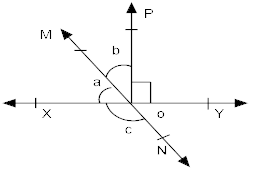
View full solution →In fig lines XY and MN intersect at O If $\angle $POY = 90° and a:b = 2:3 find $\angle $c.
View full solution →In fig the side AB and AC of $\vartriangle $ ABC are produced to point E And D respectively. If bisector BO and CO of $\angle $CBE And $\angle $BCD respectively meet at point O, then prove that $\angle $ BOC =${90^ \circ } - \frac{1}{2}\angle $ BAC
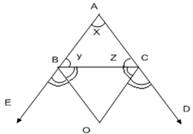
View full solution →In the given figure, $OP, OQ, OR$ and $OS$ are four rays. Prove that
$\angle POQ + \angle ROQ + \angle SOR + \angle POS = 360^\circ .$
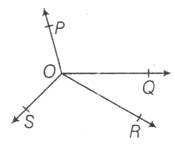
View full solution →$\angle POQ + \angle ROQ + \angle SOR + \angle POS = 360^\circ .$
Prove: Two distinct lines cannot have more than one point in common.
If two lines intersect, prove that the vertically opposite angles are equal.
In Figure lines AB and CD intersect at O. If $\angle AOC + \angle BOE = {70^ \circ }$ and $\angle BOD = {40^ \circ }$,find $\angle BOE$ and reflex $\angle COE$
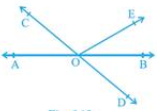
View full solution →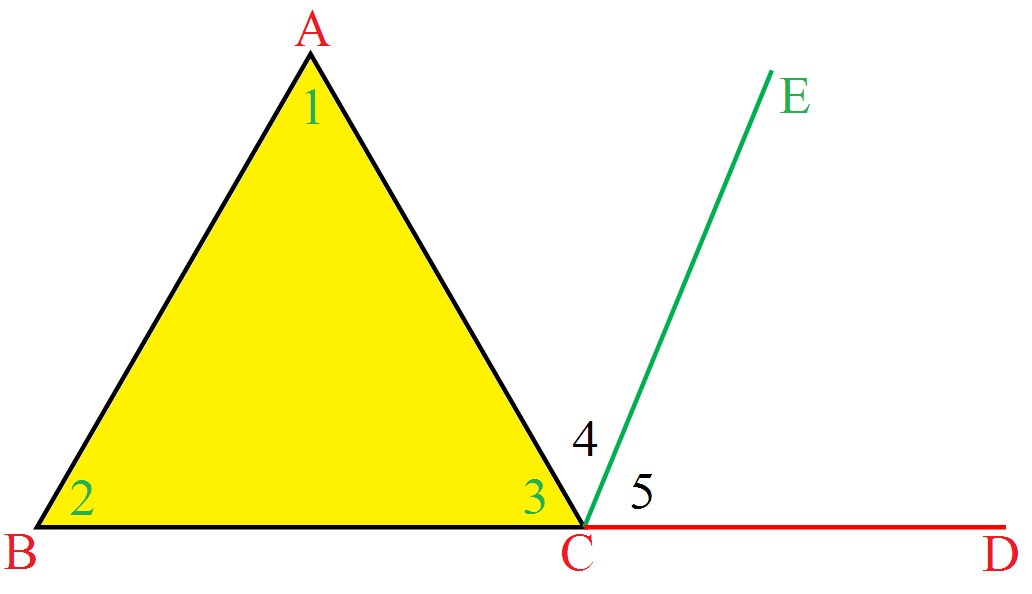
Two equilateral triangles on a straight line are shown below.
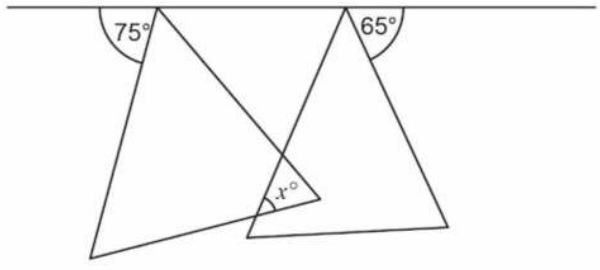
4.What is the measure of ‘x’?
A. 30
B. 40
C. 60
D. 65
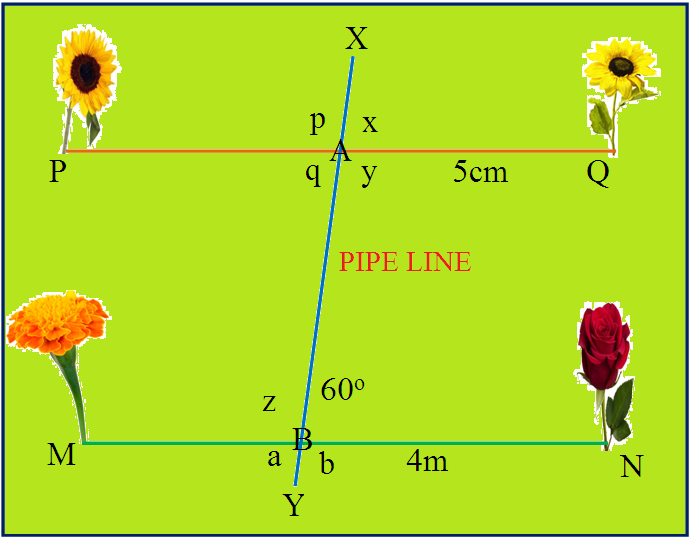
Read the Source/ Text given below and answer any four questions: There were two parallel roads $AM$ and $XY$ in New Delhi. Due to increasing pollution, $\text{MCD}$ planned to get planted trees on these roads. On the road $AM,$ plants of Ashoka were planted by one company. While on the road $XY$ mango trees were planted by another company.
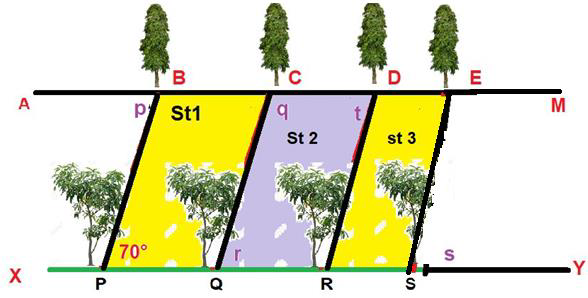
Between these roads three streets $St_1, St_2$ and $St_3$ were situated. During the survey, $\angle\text{BPQ}$ was measured to be $70^\circ$ and other angles $\text{p, q, r, s}$ and t were also measured. Now answer the following questions:
View full solution →Between these roads three streets $St_1, St_2$ and $St_3$ were situated. During the survey, $\angle\text{BPQ}$ was measured to be $70^\circ$ and other angles $\text{p, q, r, s}$ and t were also measured. Now answer the following questions:
- What is the measure of $\angle\text{p}?$
- $60^\circ$
- $70^\circ$
- $160^\circ$
- $100^\circ$
- What is the measure of $\angle\text{q}?$
- $60^\circ$
- $70^\circ$
- $160^\circ$
- $110^\circ$
- What is the value of $\frac{\text{p}+\text{q}+\text{t}}{5}?$
- $50^\circ$
- $70^\circ$
- $160^\circ$
- $100^\circ$
- What is the measure of $\angle\text{EsY}?$
- $60^\circ$
- $140^\circ$
- $70^\circ$
- $110^\circ$
- What is value of ${4p - (q + r) - (r - s)}$?
- $50^\circ$
- $100^\circ$
- $160^\circ$
- $180^\circ$
Generate a Lines and Angles paper free
Pick question groups from the list above, set marks and difficulty, and export a branded PDF with step-by-step answer keys. First 3 chapters free — no signup.