The general displacement of a simple harmonic oscillator is $x = A \sin \omega t$. Let $T$ be its time period. The slope of its potential energy (U) - time (t) curve will be maximum when $t=\frac{T}{\beta}$. The value of $\beta$ is $.........$
JEE MAIN 2023, Diffcult


Download our appand get started for free
Experience the future of education. Simply download our apps or reach out to us for more information. Let's shape the future of learning together!No signup needed.*
Similar Questions
- 1The potential energy of a particle of mass $0.1\,kg,$ moving along $x-$ axis, is given by $U = 5x(x-4)\,J$ where $x$ is in metres. It can be concluded thatView Solution
- 2View SolutionTo make the frequency double of an oscillator, we have to
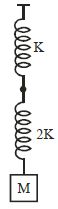
- 3Two springs of force constant $K$ and $2K$ are connected to a mass as shown below. The frequency of oscillation of the mass isView Solution
- 4The oscillation of a body on a smooth horizontal surface is represented by the equation $x= Acos$$\omega t$View Solution
where $x=$ displacement at time $t$
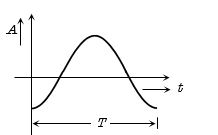
$\omega =$ frequency of oscillation
Which one of the following graphs shows correctly the variation $a$ with $t$ ?
Here $a=$ acceleration at time $t$
$T=$ time period
- 5Two particles are executing S.H.M. The equation of their motion are ${y_1} = 10\sin \left( {\omega \,t + \frac{{\pi T}}{4}} \right),$ ${y_2} = 25\sin \,\left( {\omega \,t + \frac{{\sqrt 3 \pi T}}{4}} \right)$. What is the ratio of their amplitudeView Solution
- 6A simple pendulum is set up in a trolley which moves to the right with an acceleration a on a horizontal plane. Then the thread of the pendulum in the mean position makes an angle $\theta $ with the verticalView Solution
- 7The angular amplitude of a simple pendulum is $\theta_0$. The maximum tension in its string will beView Solution
- 8A particle executes simple harmonic motion (amplitude $= A$) between $x = - A$ and $x = + A$. The time taken for it to go from $0$ to $A/2$ is ${T_1}$ and to go from $A/2$ to $A$ is ${T_2}$. ThenView Solution
- 9A particle is executing simple harmonic motion with an amplitude of $0.02$ metre and frequency $50\, Hz$. The maximum acceleration of the particle isView Solution
- 10Acceleration $A$ and time period $T$ of a body in $S.H.M.$ is given by a curve shown below. Then corresponding graph, between kinetic energy $(K.E.)$ and time $t$ is correctly represented byView Solution