Two particles are executing S.H.M. The equation of their motion are ${y_1} = 10\sin \left( {\omega \,t + \frac{{\pi T}}{4}} \right),$ ${y_2} = 25\sin \,\left( {\omega \,t + \frac{{\sqrt 3 \pi T}}{4}} \right)$. What is the ratio of their amplitude
Easy


Download our appand get started for free
Experience the future of education. Simply download our apps or reach out to us for more information. Let's shape the future of learning together!No signup needed.*
Similar Questions
- 1Two simple pendulums whose lengths are $100 cm$ and $121 cm$ are suspended side by side. Their bobs are pulled together and then released. After how many minimum oscillations of the longer pendulum, will the two be in phase againView Solution
- 2The potential energy of a particle of mass $4\,kg$ in motion along the $x$-axis is given by $U =4(1-\cos 4 x )\,J$. The time period of the particle for small oscillation $(\sin \theta \simeq \theta)$ is $\left(\frac{\pi}{ K }\right)\,s$. The value of $K$ is .......View Solution
- 3A vibratory motion is represented by $x = 2A\,\cos \omega t + A\,\cos \,\left( {\omega t + \frac{\pi }{2}} \right) + A\,\cos \,\left( {\omega t + \pi } \right)$ $ + \frac{A}{2}\,\cos \left( {\omega t + \frac{{3\pi }}{2}} \right)$. The resultant amplitude of the motion isView Solution
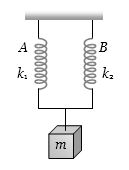
- 4A mass $m$ is suspended by means of two coiled spring which have the same length in unstretched condition as in figure. Their force constant are $k_1$ and $k_2$ respectively. When set into vertical vibrations, the period will beView Solution
- 5The potential energy of a particle of mass $0.1\,kg,$ moving along $x-$ axis, is given by $U = 5x(x-4)\,J$ where $x$ is in metres. It can be concluded thatView Solution
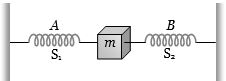
- 6In the figure, ${S_1}$ and ${S_2}$ are identical springs. The oscillation frequency of the mass $m$ is $f$. If one spring is removed, the frequency will becomeView Solution
- 7A second's pendulum is placed in a space laboratory orbiting around the earth at a height $3R$, where $R$ is the radius of the earth. The time period of the pendulum isView Solution
- 8A $S.H.M.$ has amplitude $‘a’$ and time period $T$. The maximum velocity will beView Solution
- 9A particle executes simple harmonic motion (amplitude $= A$) between $x = - A$ and $x = + A$. The time taken for it to go from $0$ to $A/2$ is ${T_1}$ and to go from $A/2$ to $A$ is ${T_2}$. ThenView Solution
- 10The periodic time of a simple pendulum of length $1\, m $ and amplitude $2 \,cm $ is $5\, seconds$. If the amplitude is made $4\, cm$, its periodic time in seconds will beView Solution