MCQ
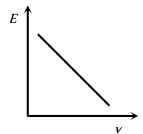
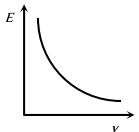
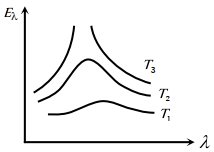
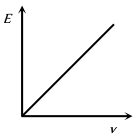
The graph between $E$ and $v$ is
  • Image
  • B
    Image
  • C
    Image
  • D
    Image

Answer

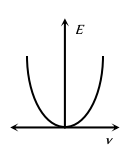
Correct option: A.
Image
Kinetic energy $E=\frac{1}{2} m v^2 \Rightarrow E \propto v^2$ graph will be parabola symmetric to $E$-axis.

Need a full question paper?

Generate a complete, print-ready paper with questions like this in minutes — across 16+ boards, with answer keys.
Start Generating Free

Similar questions

The radius of the first $($lowest$)$ orbit of the hydrogen atom is $a_0$. The radius of the second $($next higher$)$ orbit will be
A wire of length $1 \mathrm{~m}$ is moving at a speed of $2 \mathrm{~ms}$ perpendicular to its length and a homogeneous magnetic field of $0.5 T$. The ends of the wire are joined to a circuit of resistance $6 \Omega$. The rate at which work is being done to keep the wire moving at constant speed is
Intensity of $X$-rays depends upon the number of
Surface tension of a liquid is found to be influenced by
Two cylinders $A$ and $B$ fitted with pistons contain equal amounts of an ideal diatomic gas at $300 \mathrm{~K}$. The piston of $A$ is free to move while that of $B$ is held fixed. The same amount of heat is given to the gas in each cylinder. If the rise in temperature of the gas in $A$ is $30 \mathrm{~K}$, then the rise in temperature of the gas in $B$ is
A sky wave with a frequency $55\ \mathrm{MHz}$ is incident on $D$-region of earth's atmosphere at $45.$ The angle of refraction is (electron density for $D$-region is $400$ electron/ $\mathrm{cm}$ )
The temperature of a wire of length 1 metre and area of crosssection $1 cm ^2$ is increased from $0^{\circ} C$ to $100^{\circ} C$. If the rod is not allowed to increase in length, the force required will be $\left(\alpha=10^{-5} /{ }^{\circ} C\right.$ and $\left.Y=10^{11} N / m ^2\right)$
Variation of radiant energy emitted by sun, filament of tungsten lamp and welding arc as a function of its wavelength is shown in figure. Which of the following option is the correct match
Image
The de-Broglie wavelength of an electron having $80 \mathrm{eV}$ of energy is nearly $ \left(1 \mathrm{eV}=1.6 \times 10^{-19} \mathrm{J}, \text { Mass of electron }=9 \times 10^{-31} \cdot \mathrm{kg}\right. $$ \left.\text { Plank's constant }=6.6 \times 10^{\prime \prime} \mathrm{J}-\mathrm{sec}\right) $
Approximate height of ozone layer above the ground is