Question
The gravitational attraction between electron and proton in a hydrogen atom is weaker than the coulomb attraction by a factor of about 10–40. An alternative way of looking at this fact is to estimate the radius of the first Bohr orbit of a hydrogen atom if the electron and proton were bound by gravitational attraction. You will find the answer interesting.
Answer

Radius of the first Bohr orbit is given by the relation,
$\text{r}_1=\frac{4\pi\in_0\Big(\frac{\text{h}}{2\pi}\Big)^2}{\text{m}_\text{e}\text{e}^2}\ \dots(1)$
Where,
$\in_0$ = Permittivity of free space
h = Planck ' s constant = 6.63 × 10⁻³⁴ Js
me = Mass of an electron = 9.1 × 10⁻³¹ kg
e = Charge of an electron = 1.9 × 10⁻¹⁹ C
mp = Mass of a proton = 1.67 × 10⁻²⁷ kg
r = Distance between the electron and the proton
Coulomb attraction between an electron and a proton is given as:
$\text{F}_\text{C}=\frac{\text{e}^2}{4\pi\in_0\text{r}^2}\ \dots(2)$
Gravitational force of attraction between an electron and a proton is given as:
$\text{F}_\text{G}=\frac{\text{Gm}_\text{p}\text{m}_\text{c}}{\text{r}^2}\ \dots(3)$
Where,
G = Gravitational constant = 6.67 × 10⁻¹¹ N m/ kg2
If the electrostatic (Coulomb) force and the gravitational force between an electron and a proton are equal, then we can write:
$\therefore\ \text{FG}=\text{FC}$
$\frac{\text{Gm}_\text{p}\text{m}_\text{c}}{\text{r}^2}=\frac{\text{e}^2}{4\pi\in_0\text{r}^2}$
$\therefore\ \frac{\text{e}^2}{4\pi\in_0}=\text{Gm}_\text{p}\text{m}_\text{c}\ \dots(4)$
Putting the value of equation (4) in equation (1), we get:
$\text{r}_1=\frac{\Big(\frac{\text{h}}{2\pi}\Big)^2}{\text{Gm}_\text{p}\text{m}_\text{e}^2}$
$=\frac{\Big(\frac{6.63\times10^{-34}}{2\times3.14}\Big)^2}{6.67\times10^{-11}\times1.67\times10^{-27}\times(9.1\times10^{-31})^2}\approx1.21\times10^{29}\text{ m}$
It is known that the universe is 156 billion light years wide or 1.5 × 1027 m wide. Hence, we can conclude that the radius of the first Bohr orbit is much greater than the estimated size of the whole universe.

Need a full question paper?

Generate a complete, print-ready paper with questions like this in minutes — across 16+ boards, with answer keys.

Start Generating Free

Similar questions

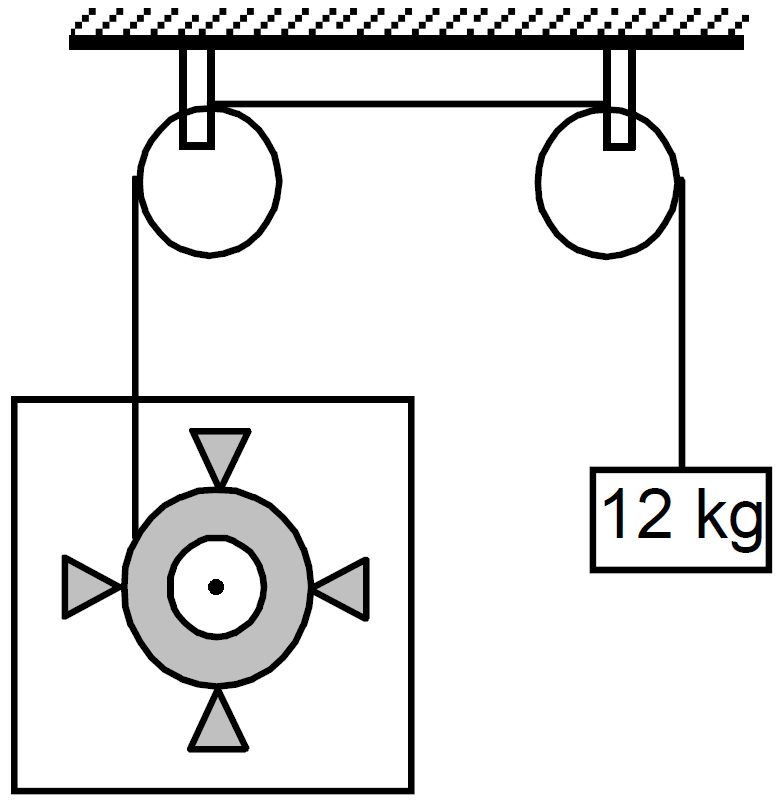
Figure. shows a paddle wheel coupled to a mass of 12kg through fixed frictionless pulleys. The paddle is immersed in a liquid of heat capacity 4200JK-1 kept in an adiabatic container. Consider a time interval in which the 12kg block falls slowly through 70cm.
  1. How much heat is given to the liquid?
  2. How much work is done on the liquid?
  3. Calculate the rise in the temperature of the liquid neglecting the heat capacity of the container and the paddle.
​​​​​​​
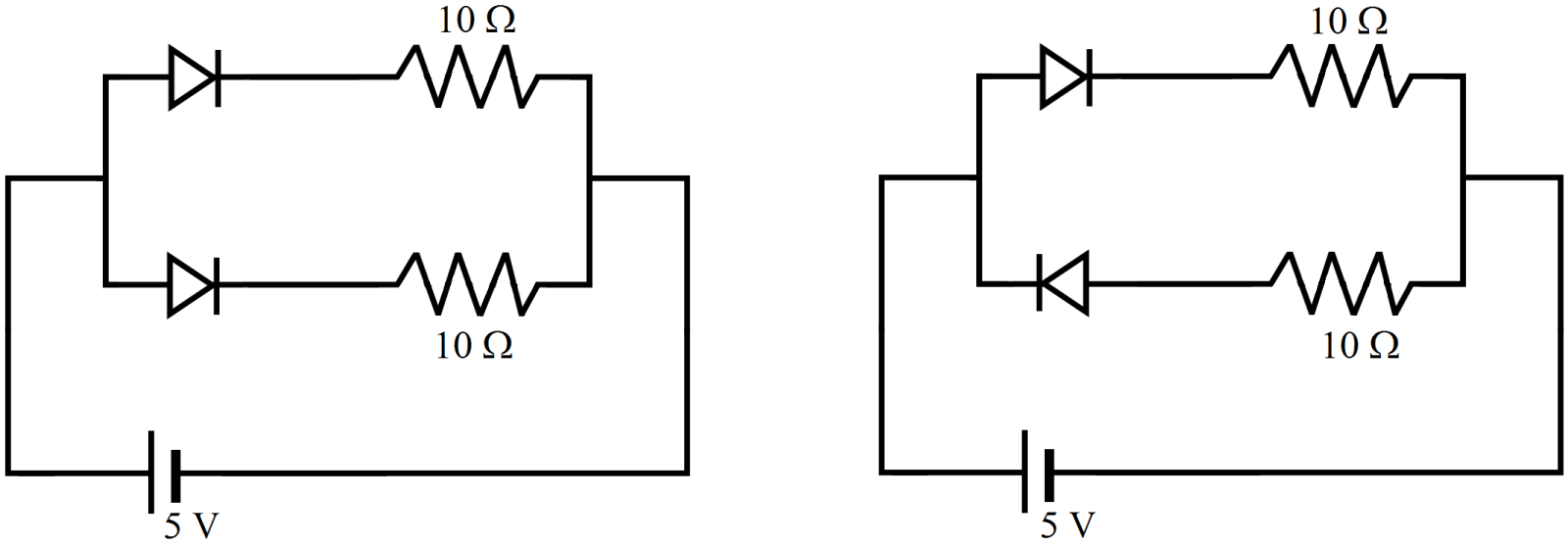
(a) Find the current in the $20\Omega$ resistor shown in the figure. (b) If a capacitor of capacitance $4\mu\text{F}$ is joined between the points A and B, what would be the electrostatic energy stored in it in steady state?

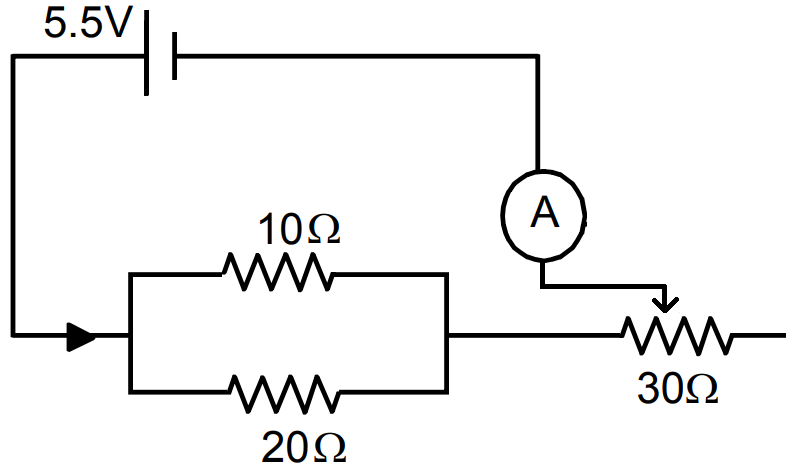
The resistance of the rheostat shown in the figure. is $30\Omega.$ Neglecting the meter resistance, find the minimum and maximum currents through the ammeter as the rheostat is varied.

Two charges 5 × 10⁻⁸ C and –3 × 10⁻⁸ C are located 16 cm apart. At what point(s) on the line joining the two charges is the electric potential zero? Take the potential at infinity to be zero.
In a Young's double slit interference experiment the fringe pattern is observed on a screen placed at a distance D from the slits. The slits are separated by a distance d and are illuminated by monochromatic light of wavelength $\lambda$. Find the distance from the central point where the intensity falls to,
  1. Half the maximum.
  2. One fourth of the maximum.
An optical instrument used for angular magnification has a 25D objective and a 20D eyepiece. The tube length is 25cm when the eye is least strained.
  1. Whether it is a microscope or a telescope?
  2. What is the angular magnification produced?
If neutrons exert only attractive force, why don't we have a nucleus containing neutrons alone?
An LR circuit has L = 1.0H and $\text{R}=20\Omega.$ It is connected across an emf of 2.0V at t = 0. Find $\frac{\text{di}}{\text{dt}}$ at:
  1. t = 100ms
  2. t = 200ms
  3. t = 1.0s
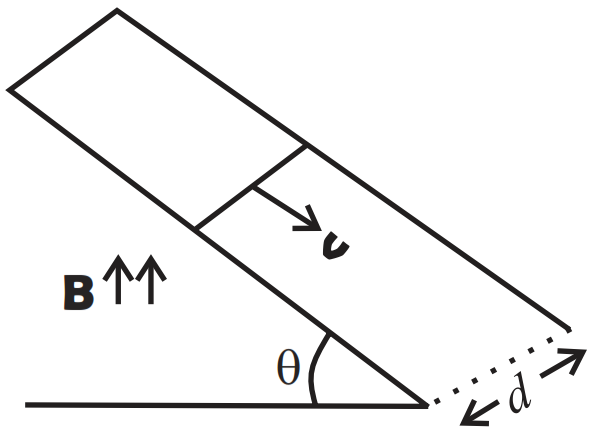
A rod of mass m and resistance R slides smoothly over two parallel perfectly conducting wires kept sloping at an angle θ with respect to the horizontal (Fig). The circuit is closed through a perfect conductor at the top. There is a constant magnetic field B along the vertical direction. If the rod is initially at rest, find the velocity of the rod as a function of time.