The $H$ amount of thermal energy is developed by a resistor in $10\,s$ when a current of $4\,A$ is passed through it. If the current is increased to $16\,A$, the thermal energy developed by the resistor in $10\,s$ will be $........\,H$
JEE MAIN 2023, Medium


Download our appand get started for free
Experience the future of education. Simply download our apps or reach out to us for more information. Let's shape the future of learning together!No signup needed.*
Similar Questions
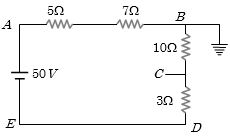
- 1In the circuit shown, the point ‘$B$’ is earthed. The potential at the point ‘$A$’ is ............. $V$View Solution
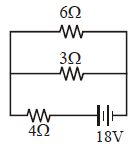
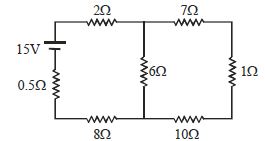
- 2The total power dissipated (in $watt$ ) in the circuit shown isView Solution
- 3A cell of $e.m.f.$ $1.5\,V$ having a finite internal resistance is connected to a load resistance of $2\,\Omega $. For maximum power transfer the internal resistance of the cell should be ............. $ohm$View Solution
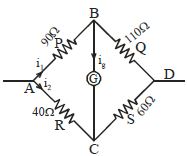
- 4In a Wheatstone bridge, $P = 90\,\Omega $, $Q = 110\,\Omega $ , $R = 40\,\Omega $ and $S = 60\,\Omega $ and a cell of $4\,V\,emf$. Then the potential difference between the diagonal along which a galvanometer is connected is ............. $V$View Solution
- 5A uniform metallic wire carries a current $2\,A$. when $3.4\,V$ battery is connected across it. The mass of uniform metallic wire is $8.92 \times 10^{-3} \,kg$. density is $8.92 \times 10^3\,kg / m ^3$ and resistivity is $1.7 \times 10^{-8} \Omega- m$. The length of wire is $l=............\,m$View Solution
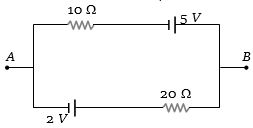
- 6The current in the given circuit is ................ $A$View Solution
- 7Two cells of $e.m.f.$ $E_1$ and $E_2$ are joined in series and the balancing length of the potentiometer wire is $625$ $cm$. If the terminals of $E_1$ are reversed, the balancing length obtained is $125 \,cm$. Given $E_2 > E_1$, the ratio $E_1: E_2$ will beView Solution
- 8The current from the battery in the given circuit is ................ $A$View Solution
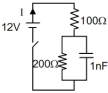
- 9Find the charge in steady state of the capacitor. (in $nC)$View Solution
- 10A wire of resistance $R$ is divided in $10$ equal parts. These parts are connected in parallel, the equivalent resistance of such connection will beView Solution