Two cells of $e.m.f.$ $E_1$ and $E_2$ are joined in series and the balancing length of the potentiometer wire is $625$ $cm$. If the terminals of $E_1$ are reversed, the balancing length obtained is $125 \,cm$. Given $E_2 > E_1$, the ratio $E_1: E_2$ will be
Medium


Download our appand get started for free
Experience the future of education. Simply download our apps or reach out to us for more information. Let's shape the future of learning together!No signup needed.*
Similar Questions
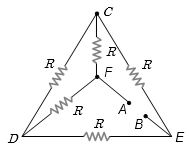
- 1Five equal resistances each of resistance $R$ are connected as shown in the figure. A battery of $V\, volts$ is connected between $A$ and $B$. The current flowing in $AFCEB$ will beView Solution
- 2View SolutionOhm's law fails in
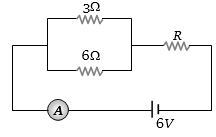
- 3If the ammeter in the given circuit reads $2\, A$, the resistance $R$ is ............ $ohm$View Solution
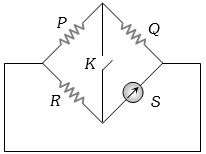
- 4In the following Wheatstone bridge $P/Q = R/S$. If key $K$ is closed, then the galvanometer will show deflectionView Solution
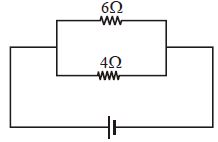
- 5In the circuit shown, the power developed in the $6\,\Omega $ resistor is $6\,W.$ The power developed in the $4\,\Omega $ resistor is .............. $W$View Solution
- 6A heating coil can heat the water of a vessel from $20\,^oC$ to $60\,^oC$ in $30$ minutes. Two such heating coils are put in series and then used to heat the same amount of water through the same temperature range. The time taken now will be ............ $min$ (neglecting thermal capacity of the coils)View Solution
- 7The drift velocity of electrons for a conductor connected in an electrical circuit is $V _{ d }$. The conductor in now replaced by another conductor with same material and same length but double the area of cross section. The applied voltage remains same. The new drift velocity of electrons will beView Solution
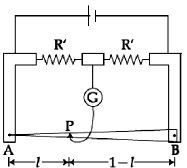
- 8In a meter bridge, the wire of length $1\, m$ has a nonuniform cross-section such that, the variation $\frac{{dR}}{{d\ell }}$ of its resistance $R$ with length $\ell $ is $\frac{{dR}}{{d\ell }} \propto \frac{1}{{\sqrt \ell }}$ Two equal resistances are connected as shown in the figure. The galvanometer has zero deflection when the jockey is at point $P$. What is the length $AP$ ? ................ $m$View Solution
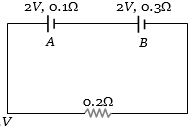
- 9The internal resistances of two cells shown are $0.1\,\Omega $ and $0.3\,\Omega $. If $R = 0.2\,\Omega $, the potential difference across the cellView Solution
- 10The resistance of a wire of iron is $10\, ohms$ and temp. coefficient of resistivity is $5 \times {10^{ - 3}}\,^oC$. At $20\,^oC$ it carries $30$ milliamperes of current. Keeping constant potential difference between its ends, the temperature of the wire is raised to $120\,^oC$. The current in milliamperes that flows in the wire isView Solution