Question
The heat current is written as $\frac{\triangle\text{Q}}{\triangle\text{t}}.$ Why don't we write $\frac{\text{dQ}}{\text{dt}}?$

Answer

The amount of heat crossing through any cross-section of a slab in time $\triangle\text{t}$ is called heat current.
It is written as $\frac{\triangle\text{Q}}{\triangle\text{t}}$ and not as complete derivative $\frac{\text{dQ}}{\text{dt}}.$
This is because the amount of heat crossing through any cross section is a function of many variables like temperature difference, area of cross-section, etc.
So, we cannot write it as a complete derivative with respect to time.

Need a full question paper?

Generate a complete, print-ready paper with questions like this in minutes — across 16+ boards, with answer keys.
Start Generating Free

Similar questions

We have valence electrons and conduction electrons in a semiconductor. Do we also have 'valence holes' and 'conduction holes'?
Find the magnetic field B due to a semicircular wire of radius 10.0cm carrying a current of 5.0A at its centre of curvature.
A 12.3 eV electron beam is used to bombard gaseous hydrogen at room temperature. Upto which energy level the hydrogen atoms would be excited?
Calculate the wavelengths of the second member of Lyman series and second member of Balmer series.
A 5.0 diopter lens forms a virtual image which is 4 times the object placed perpendicularly on the principal axis of the lens. Find the distance of the object from the lens.
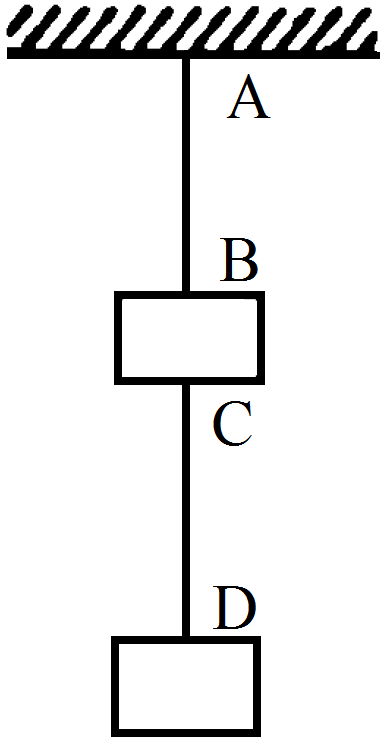
Two blocks each having a mass of 3.2kg are connected by a wire CD and the system is suspended from the ceiling by another wire AB figure, The linear mass delity of the wire AB is 10g/m and that of CD is 8g/m. Find the speed of a transverse wave pulse produced in AB and in CD.

A hydrogen atom in ground state absorbs a photon of ultraviolet radiation of wavelength 50nm. Assuming that the entire photon energy is taken up by the electron with what kinetic energy will the electron be ejected?
Give reasons for each of the following:
  1. The intensity of light at some points on the screen in Young’s double slit experiment is zero.
  2. The intensity of light transmitted by a polaroid is less than the intensity of the unpolarised light incident on it.
  3. In the single slit diffraction experiment, some coloured fringes around the central white maximum are observed on the screen when one uses a source of white light.
Draw the graph of binding energy per nucleon against atomic mass number and draw conclusion of the graph.
Estimate the number of electrons in 100g of water. How much is the total negative charge on these electrons?
Define an equipotential surface. Draw equipotential surface:

  1. In the case of a single point charge and,
  2. In a constant electric field in Z-direction.

Why the equipotential surfaces about a single charge are not equidistant?

  1. Can electric field exist tangential to an equipotential surface? Give reason.