Question
The heat current is written as $\frac{\triangle\text{Q}}{\triangle\text{t}}.$ Why don't we write $\frac{\text{dQ}}{\text{dt}}?$

Answer

The amount of heat crossing through any cross-section of a slab in time $\triangle\text{t}$ is called heat current.
It is written as $\frac{\triangle\text{Q}}{\triangle\text{t}}$ and not as complete derivative $\frac{\text{dQ}}{\text{dt}}.$
This is because the amount of heat crossing through any cross section is a function of many variables like temperature difference, area of cross-section, etc.
So, we cannot write it as a complete derivative with respect to time.

Need a full question paper?

Generate a complete, print-ready paper with questions like this in minutes — across 16+ boards, with answer keys.
Start Generating Free

Similar questions

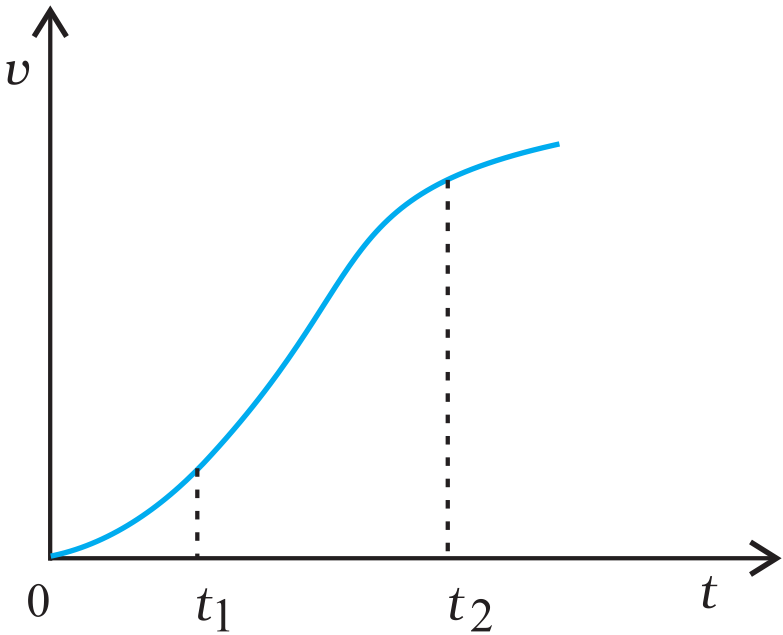
 The velocity-time graph of a particle in one-dimensional motion is shown in:

Which of the following formulae are correct for describing the motion of the particle over the time-interval t1 to t2:

  1. x(t2) = x(t1) + v(t1) (t2 – t1) + (1/2) a(t2 – t1)2

  2. v(t2) = v(t1) + a(t2 – t1)

  3. vaverage = (x(t2) –x(t1))/(t2 – t1)

  4. aaverage = (v(t2) –v(t1))/(t2 – t1)

  5. x(t2) = x(t1) + vaverage (t2 – t1) + (1/2) aaverage (t2 – t1)2

  6. x(t2) – x(t1) = area under the v-t curve bounded by the t-axis and the dotted line shown. 

Explain the concept of absolute zero of temperature on the basis of kinetic theory of gases.
A simple pendulum of lerigth 1 feet suspended from the ceiling of an elevator takes $\frac{\pi}{3}$ seconds to complete one oscillation. Find the acceleration of the elevator.
Explain that torque is only due to transverse component of force. Radial component has nothing to do with torque.
Molar volume is the volume occupied by 1mol of any (ideal) gas at standard temperature and pressure:
(STP: 1 atmospheric pressure, 0°C). Show that it is 22.4 litres.
What is Einstein's energy-mass equivalence? Explain the energy output of a mass on the basis of this relationship. Give two situations where this relationship can be employed. Also calculate energy released from complete annihilation of 1g matter.
If several forces act on a particle, the total torque on the particle may be obtained by first finding the resultant force and then taking torque of this resultant. Prove this. Is this result valid for the forces acting on different particles of a body in such a way that their lines of action intersect at a common point?
The moment of inertia of a uniform rod of mass 0.50kg and length 1m is 0.10kg-m2 about a line perpendicular to the rod. Find the distance of this line from the middle point of the rod.
A hydrogen atom in state n = 6 makes two successive transitions and reaches the ground state. In the first transition a photon of 1.13eV is emitted. (a) Find the energy of the photon emitted in the second transition (b) What is the value of n in the intermediate state?
An ice cube of mass 0.1 kg at $0^{\circ} C$ is placed in an isolated container which is at $227^{\circ} C$. The specific heat S of the container varies with temperature T according to the empirical relation $S = A + BT$, where $A =100 cal / kg - K$ and $B=2 \times 10^{-2} cal / kg - K ^2$. If the final temperature of the container is $27^{\circ} C$, determine the mass of the container. (Latent heat of fusion of water $=8 \times 10^4$ call kg. Specific heat of water $=10^3 cal / kg - K$ ).