MCQ
The helical structure of protein is stabilised by
  • A
    Depeptide bond
  • Hydrogen bond
  • C
    Ether bond
  • D
    Ester bond

Answer

Correct option: B.
Hydrogen bond
b
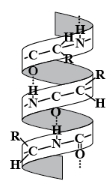
The helical structure of proteins is stabilized by hydrogen bonds. In helical structure, the carbonyl oxygen atoms in $C = O$ points in one direction, towards the amide hydrogen atoms in $NH$ groups,$4$ residues away. Together these groups form a hydrogen bond, one of the main forces of secondary structure stabilization in proteins. Hydrogen bonds are shown by dashed lines.

Need a full question paper?

Generate a complete, print-ready paper with questions like this in minutes — across 16+ boards, with answer keys.

Start Generating Free

Similar questions

Hydrogen bonding does not play any role in boiling of
Which of the following is not a coenzyme?
The most important oxidation state of copper is
Out of the following coordination entities which is chiral (opticaly active) ?
Match the following:
Column $I$ Column $II$
$(A)$ $\mathrm{CH}_3-\mathrm{CHBr}-\mathrm{CD}_3$ on treatment with alc. $\mathrm{KOH}$ gives $\mathrm{CH}_2=\mathrm{CH}-\mathrm{CD}_3$ as a major product. $(P)$ $E1$ reaction
$(B)$ $\mathrm{Ph}-\mathrm{CHBr}-\mathrm{CH}_3$ reacts faster than $\mathrm{Ph}-\mathrm{CHBr}-\mathrm{CD}_3$. $(Q)$ $E2$ reaction
$(C)$ $\mathrm{Ph}-\mathrm{CH}_2-\mathrm{CH}_2 \mathrm{Br}$ on treatment with $\mathrm{C}_2 \mathrm{H}_5 \mathrm{OD} / \mathrm{C}_2 \mathrm{H}_5 \mathrm{O}^{-}$ gives $\mathrm{Ph}-\mathrm{CD}=\mathrm{CH}_2$ as the major product. $(R)$ $E1$ cb reaction
$(D)$ $\mathrm{PhCH}_2 \mathrm{CH}_2 \mathrm{Br}$ and $\mathrm{PhCD}_2 \mathrm{CH}_2 \mathrm{Br}$ react with same rate. $(S)$ First order reaction
The ether that undergoes electrophilic substitution reactions is
The reaction, $C{H_3}Br + Na \to {\rm{Product}}$, is called
The equivalent conductance of monobasic acid at infinite dilution is $348\, ohm^{-1}\, cm^2\, eq^{-1}$. If the resistivity of the solution containing $15\, g$ acid ($mol.\, wt. 49$) in $1\, litre$ is $18.5\, ohm\, cm$. What is the degree of dissociation of acid? .............. $\%$
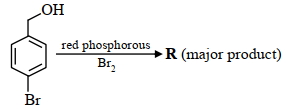
Consider the following reaction. On estimation of bromine in $1.00 g$ of $R$ using Carius method, the amount of $AgBr$ formed (in $g$ ) is. . . .

$\overline{\text { [Given : }}$ Atomic mass of $H =1, C =12, O =16, P =31, Br =80, Ag =108]$
Which are not cleaved by $HIO_4$ ?

$I :$ glycerol                                           $II : $ glycol

$III : 1 , 3-$ propenediol                  $IV :$ methoxy $ -2- $ propanol