MCQ
The high density of water compared to ice is due to
- ✓Hydrogen bonding interactions
- BDipole-dipole interactions
- CDipole-induced dipole interactions
- DInduced dipole-induced dipole interactions
Generate a complete, print-ready paper with questions like this in minutes — across 16+ boards, with answer keys.

$XNa_2HAsO_3 + YNaBrO_3 + ZHCl \longrightarrow$
$NaBr + H_3AsO_4 + NaCl$
The values of $X, Y$ and $Z$ in the above redox reaction are respectively
If $T_1=2 T_2$ and $\left(\Delta G_2^{\Theta}-\Delta G_1^{\varphi}\right)=R T_2 \ln x$, then the value of $x$ is. . . . .
$\left[\Delta G_1^\theta\right.$ and $\Delta G_2^\theta$ are standard Gibb's free energy change for the reaction at temperatures $T_1$ and $T_2$, respectively.]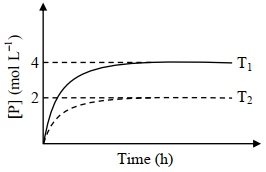
$(i)\,\begin{array}{*{20}{c}}
{C{H_3} - \mathop C\limits^ \oplus - C{H_3}} \\
| \\
{\,\,\,\,\,\,OC{H_3}}
\end{array}$
$(ii)\,\begin{array}{*{20}{c}}
{C{H_3} - \mathop C\limits^ \oplus - C{H_3}} \\
| \\
{\,\,\,\,\,\,C{H_3}}
\end{array}$
$(iii)\begin{array}{*{20}{c}}
{C{H_3} - \mathop C\limits^ \oplus {H_2} - NH} \\
{\,\,\,\,\,\,\,\,\,\,\,\,\,\,\,\,\,\,\,\,\,\,\,\,\,\,\,\,\,\,\,\,\,\,|} \\
{\,\,\,\,\,\,\,\,\,\,\,\,\,\,\,\,\,\,\,\,\,\,\,\,\,\,\,\,\,\,\,\,\,\,\,\,\,\,C{H_3}}
\end{array}$
$(iv)\,C{H_3} - \mathop C\limits^ \oplus {H_2}$