MCQ
The horizontal range and maximum height attained by a projectile are $R$ and $H$, respectively. If a constant horizontal acceleration $a=g / 4$ is imparted to the projectile due to wind, then its horizontal range and maximum height will be
  • A
    $(R+H), \frac{H}{2}$
  • B
    $\left(R+\frac{H}{2}\right), 2 H$
  • C
    $( R +2 H ), H$
  • $(R+H), H$

Answer

Correct option: D.
$(R+H), H$
d
(d)

$H=H$ (as vertical component of acceleration has not changed)

$R^{\prime} =u_x T+\frac{1}{2} a_x T^2$

$=R+\frac{1}{2} \times \frac{g}{4} \times \frac{4 u^2 \sin ^2 \theta}{g^2}$

$=R \frac{u^2 \sin ^2 \theta}{2 g}=(R+H)$

Need a full question paper?

Generate a complete, print-ready paper with questions like this in minutes — across 16+ boards, with answer keys.

Start Generating Free

Similar questions

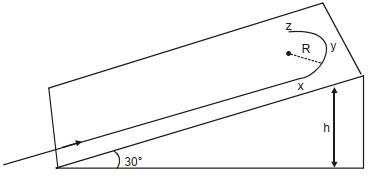
A student skates up a ramp that makes an angle $30^{\circ}$ with the horizontal. $He /$ she starts (as shown in the figure) at the bottom of the ramp with speed $v_0$ and wants to turn around over a semicircular path xyz of radius $R$ during which he/she reaches a maximum height $h$ (at point y) from the ground as shown in the figure. Assume that the energy loss is negligible and the force required for this turn at the highest point is provided by his/her weight only. Then ( $g$ is the acceleration due to gravity)

$(A)$ $v_0^2-2 g h=\frac{1}{2} g R$

$(B)$ $v_0^2-2 g h=\frac{\sqrt{3}}{2} g R$

$(C)$ the centripetal force required at points $x$ and $z$ is zero

$(D)$ the centripetal force required is maximum at points $x$ and $z$

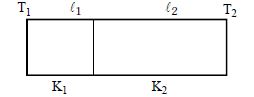
One end of a thermally insulated rod is kept at a temperature $T_1$ and the other at $T_2$. The rod is composed of two sections of lengths $l_1$ and $l_2$ and thermal conductivities $K_1$ and $K_2$ respectively. The temperature at the interface of the two sections is
It is not possible to write directly on blotting paper or newspaper with ink pen
A wheel is subjected to uniform angular acceleration about its axis. Initially its angular velocity is zero. In the first $2$ sec, it rotates through an angle ${\theta _1}$. In the next $2$ sec, it rotates through an additional angle ${\theta _2}$. The ratio of ${\theta _2}\over{\theta _1}$ is
A person can throw a ball upto a maximum range of $100 \,m$. How high above the ground he can throw the same ball?
A particle executing $\text{SHM}$ has a maximum speed of $30\ cm/ s$ angular frequency $10\text{rad/ s}$. The amplitude of oscillation is:
At a given temperature if ${V_{rms}}$ is the root mean square velocity of the molecules of a gas and ${V_s}$ the velocity of sound in it, then these are related as $\left( {\gamma = \frac{{{C_P}}}{{{C_v}}}} \right)$
An earth satellite of mass $m$ revolves in a circular orbit at a height $h$ from the surface of the earth. $R$ is the radius of the earth and $g$ is acceleration due to gravity at the surface of the earth. The velocity of the satellite in the orbit is given by
A shell of mass $200\, gm$ is ejected from a gun of  mass $4\, kg$ by an explosion that generates $1.05\, kJ$ of energy. The initial velocity of the shell is .............. $\mathrm{ms}^{-1}$
An electric lift with a maximum load of $2000\,kg$ (lift+ passengers) is moving up with a constant speed of $1.5\,ms ^{-1}$. The frictional force opposing the motion is $3000\,N$. The minimum power delivered by the motor to the lift in watts is: $\left(g=10\,ms^{-2}\right)$