MCQ
The interference of light was first demonstrated experimentally by:
- ASir Isaac Newton
- BMichelson
- CFraunhoffer
- DThomas Young
Explanation:
Thomas Young demonstrated the phenomenon of interference in water waves.
In 1801, he presented a famous paper to the Royal Society entitled "On the Theory of Light and Colours" which described various interference phenomena, and in 1803 he performed his famous double-slit experiment.
Generate a complete, print-ready paper with questions like this in minutes — across 16+ boards, with answer keys.
A point object O is placed on the principal axis of a convex lens of focal length f = 20cm at a distance of 40cm to the left of it. The diameter of the lens is 10cm. An eye is placed 60cm to right of the lens and a distance h below the principal axis. The maximum value of h to see the image is:
A group of bright and faint stars is called
|
(a) Galaxy |
(b) Comet |
(c) Black hole |
(d) Constellation |
In the nuclear reaction  is
is
|
(a) |
(b) |
(c) |
(d) |
A square metallic wire loop of side 0.1 m and resistance of 1W is moved with a constant velocity in a magnetic field of 2 wb/m2 as shown in figure. The magnetic field is perpendicular to the plane of the loop, loop is connected to a network of resistances. What should be the velocity of loop so as to have a steady current of 1mA in loop
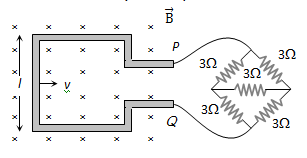
|
(a) 1 cm/sec |
(b) 2 cm/sec |
(c) 3 cm/sec |
(d) 4 cm/sec |
Assertion : A metal piece and a non-metal (stone) piece are dropped from the same height near earth’s surface. Both will reach the earth’s surface simultaneously.
Reason : There is no effect of earth’s magnetic field on freely falling body.
|
(a) If both assertion and reason are true and the reason is the correct explanation of the assertion. |
|
(b) If both assertion and reason are true but reason is not the correct explanation of the assertion. |
|
(c) If assertion is true but reason is false. |
|
(d) If the assertion and reason both are false. |
An X-ray tube is operating at 50 kV and 20 mA. The target material of the tube has a mass of 1.0 kg and specific heat 495 J kg-1  . One percent of the supplied electric power is converted into X-rays and the entire remaining energy goes into heating the target. Then
|
(a) A suitable target material must have a high melting temperature |
|
(b) The average rate of rise of temperature of target would be 2 °C/s |
|
(c) The minimum wavelength of the X-rays emitted is about 0.25 |
|
(d) a, b, c |
The resistance of an incandescent lamp is
|
(a) Greater when switched off |
|
(b) Smaller when switched on |
|
(c) Greater when switched on |
|
(d) The same whether it is switched off or switched on |


