MCQ
The intermediate formed in this reaction.
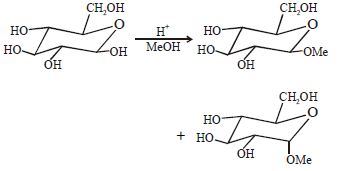
  • A
    Carbocation which does not undergo resonance
  • B
    Carbocation which undergo rearrangement
  • Carbocation which undergoes resonance
  • D
    Free radical which does not undergo resonance

Answer

Correct option: C.
Carbocation which undergoes resonance
c

Need a full question paper?

Generate a complete, print-ready paper with questions like this in minutes — across 16+ boards, with answer keys.

Start Generating Free

Similar questions

Which of the following compounds is colourless
Unpleasant smelling carbylamines are formed by heating alkali and chloroform with
Which is the weakest base
$\begin{array}{*{20}{c}}
  {C{H_3}\,\,\,\,\,\,\,\,\,\,\,\,\,\,\,\,\,\,\,\,\,\,\,\,\,\,\,\,\,\,\,\,\,\,\,\,\,\,\,\,\,\,\,\,\,\,\,\,\,\,\,\,\,\,\,\,\,\,\,\,\,\,\,\,\,\,\,\,\,\,\,\,\,\,\,\,\,\,\,\,\,\,\,} \\ 
  {|\,\,\,\,\,\,\,\,\,\,\,\,\,\,\,\,\,\,\,\,\,\,\,\,\,\,\,\,\,\,\,\,\,\,\,\,\,\,\,\,\,\,\,\,\,\,\,\,\,\,\,\,\,\,\,\,\,\,\,\,\,\,\,\,\,\,\,\,\,\,\,\,\,\,\,\,\,\,\,\,\,\,\,\,\,\,\,\,\,} \\ 
  {C{H_3} - C = C{H_2} + {{(C{H_3})}_2}CHC{H_3}\xrightarrow[{273\,K}]{{HF}}{C_8}{H_{18}}(A)} 
\end{array}$ Unknown $(A)$ in the above reaction is
$pK _{ a }$ of a weak acid $(HA)$ and $pK _{ b }$ of a weak base $( BOH )$ are 3.2 and 3.4, respectively. The pH of their salt ($A B$) solution is :
Increasing order of atomic radii is
For a reaction; $A + B \rightleftharpoons C + D$ , the initial concentration of $A$ and $B$ are equal but the equilibrium concentration of $C$ is twice that of equilibrium concentration of $A$. The $K_c$ is
The number of ions from the following that are expected to behave as oxidising agent is:

$\mathrm{Sn}^{4+}, \mathrm{Sn}^{2+}, \mathrm{Pb}^{2+}, \mathrm{Tl}^{3+}, \mathrm{Pb}^{4+}, \mathrm{Tl}^{+}$

The solubility product constant ${K_{sp}} $ of $Mg{(OH)_2}$ is $9.0 \times {10^{ - 12}}.$ If a solution is $0.010\,\,M$ with respect to $M{g^{2 + }}$ ion, what is the maximum hydroxide ion concentration which could be present without causing the precipitation of $Mg\,{(OH)_2}$
$A _2+ B _2 \rightarrow 2 AB \cdot \Delta H _{ l }^0=-200\,kJmol ^{-1}$

$AB , A _2$ and $B _2$ are diatomic molecule. If the bond enthalpies of $A _2, B _2$ and $AB$ are in the ratio $1: 0.5: 1$, then the bond enthalpy of $A_2$ is $......\,kJ\,mol ^{-1}$ (Nearest integer)