Question
The ionization potential for second He electron is (a) 13.6 eV(b) 27.2 eV(c) 54.4 eV(d) 100 eV
       

Answer

(c) 54.4 eV

Need a full question paper?

Generate a complete, print-ready paper with questions like this in minutes — across 16+ boards, with answer keys.

Start Generating Free

Similar questions

In order to increase the sensitivity of a moving coil galvanometer, one should decrease(a) The strength of its magnet(b) The torsional constant of its suspension (c) The number of turns in its coil   (d) The area of its coil
   
   
Capacitance $($in $F)$ of a spherical conductor with radius $1m$ is
Two parallel conductors A and B of equal lengths carry currents I and 10 I, respectively, in the same direction. Then(a) A and B will repel each other with same force(b) A and B will attract each other with same force(c) A will attract B, but B will repel A(d) A and B will attract each other with different forces


In the Geiger-Marsden experiment, the force that scatters particles is:
The mechanical equivalent of heat:
  1. Has the same dimension as heat.
  2. Has the same dimension as work.
  3. Has the same dimension as energy.
  4. Is dimensionless.
The net electric flux through a closed surface is:
A bar magnet is released from rest along the axis of a very long, vertical copper tube. After some time the magnet:
Kirchoff’s I law and II law of current, proves the(a) Conservation of charge and energy(b) Conservation of current and energy(c) Conservation of mass and charge(d) None of these


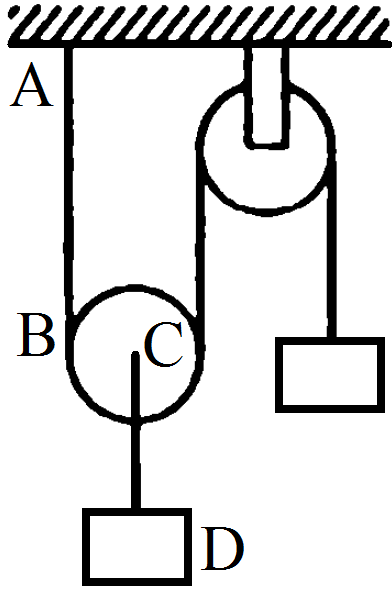
Both the strings, shown in figure are made of same material and have same cross$-$section. The pulleys are light. The wave speed of a transverse wave in the string $AB$ is $\nu_1$ and in $CD$ it is $\nu_2.$ Then $\frac{\nu_1}{\nu_2}$ is:
An electric current passes through a long straight wire. At a distance $5 \ cm$ from the wire, The magnetic field is $B.$ The field at $20 \ cm$ from the wire would be