MCQ
The $IUPAC$ name of the compound $CH_3CH=CHC\equiv  CH$ is
  • A
    pent${-4}-$yn$-{2-}$ene
  • pent$-{3-}$en$-1-$yne
  • C
    pent$-{2-}$en${-4}-$yne
  • D
    pent$-1-$yn$-{3-}$ene

Answer

Correct option: B.
pent$-{3-}$en$-1-$yne
b
$\mathop {\mathop {C{H_3}}\limits^5  - \mathop {CH}\limits^4  = \mathop {CH}\limits^3  - \mathop C\limits^5  \equiv \mathop {CH}\limits^1 }\limits_{pent\, - \,3\,\, - \,en\, - \,1\,\, - \,yne} $

Need a full question paper?

Generate a complete, print-ready paper with questions like this in minutes — across 16+ boards, with answer keys.

Start Generating Free

Similar questions

The reaction of elemental $P_4$ and aqueous $NaOH$ gives
Consider the following reaction involving two acids shown below : formic acid and.$HF.$

Which of the following statements about this reaction are true ?
$(A)$ Formic acid is the strongest Bronsted acid in the reaction
$(B)\, HF$ is the strongest Bronsted acid in the reaction
$(C)\, KF$ is the strongest Bronsted base in the reaction
$(D)\, KO_2CH$ is the strongest Bronsted base in the reaction
$(E)$ The equilibrium favours the reactants
$(F)$ The equilibrium favours the products
$(G)$ Formic acid has a weaker conjugate base
$(H)\, HF$ has a weaker conjugate base

Which of the following number of lone pair at central atom zero

$XeO _{3}, XeO _{2} F _{2}, XeO _{4}, XeO _{3} F _{2}, Ba _{2} XeF _{4}$

The number of electrons required to deposit $ 1\,gm $ atom of aluminium (at. wt. $= 27$) from a solution of aluminium chloride will be ............ $\mathrm{N}$ (where $N$  is Avogadro's number)
The following complexes are given :

$(1)$ trans $-[Co(NH_3)_4 Cl_2]^+$

$(2)$ cis $-[Co(NH_3)_2 (en)_2]^{3+}$

$(3)$ trans $-[Co(NH_3)_2(en)_2]^{3+}$

$(4)$ $NiCl^{2-}_4$

$(5)$ $TiF^{2-}_6$

$(6)\, CoF^{3-}_6$

Choose the correct code

Identify $Z$ in the sequence of reactions : 

$CH_3 CH_2 CH=CH_2  \xrightarrow{{HBr/{H_2}{o_2}}}\,Y\,\xrightarrow{{{C_2}{H_5}ONa}}Z$
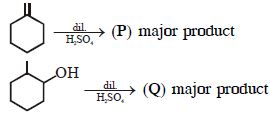
Select the incorrect option?
The element with atomic number $36$ belongs to …… block in the periodic table
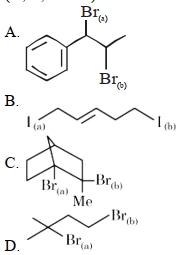
Choose the halogen which is most reactive towards $SN1$ reaction in the given compounds $(A, B, C , D)$
The metals present in insulin and haemoglobin are respectively