MCQ
The IUPAC name of the compound is:
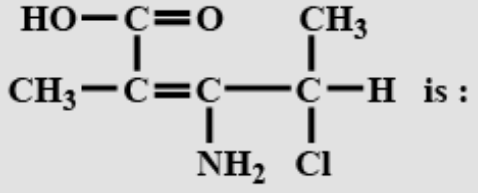
- A2 - Amino - 3 - chloro - 2 - methylpent - 2 - enoic acid
- B3 - Amino - 4 - chloro - 2 - methylpent - 2 - enoic acid
- C4- Amino -3 - chloro - 2 - methylpent - 2 - enoic acid
- DAll of the above
Explanation:
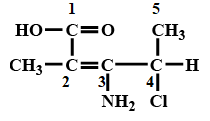
3-amino-4-chloro-2-methylpent-2-enoic acid.
In IUPAC nomenclature carboxylic acid gets first priority, then -ene, -amino group, -chloro group and -methyl group.
Generate a complete, print-ready paper with questions like this in minutes — across 16+ boards, with answer keys.
$\Delta_f G^0[\mathrm{C}(\text { graphite })]=0 \mathrm{kJmol}^{-1}$
$\Delta_f G^0[\mathrm{C}(\text { diamond })]=2.9 \mathrm{kJmol}^{-1}$
The standard state means that the pressure should be $1$ bar, and substance should be pure at a given temperature. The conversion of graphite [C(graphite)] to diamond [C(diamond)] reduces its volume by $2 \times 10^{-6} \mathrm{~m}^3 \mathrm{~mol}^{-1}$. If $\mathrm{C}$ (graphite) is converted to $\mathrm{C}$ (diamond) isothermally at $\mathrm{T}=298 \mathrm{~K}$, the pressure at which $C$ (graphite) is in equilibrium with C(diamond), is
[Useful information: $1 \mathrm{~J}=1 \mathrm{~kg} \mathrm{~m}^2 \mathrm{~s}^{-2} ; 1 \mathrm{~Pa}=1 \mathrm{~kg} \mathrm{~m}^{-1} \mathrm{~s}^{-2} ; 1 \mathrm{bar}=10^5 \mathrm{~Pa}$ ]
$C{H_3}C{H_2}C{H_2}OH \xrightarrow{PCl_3}A\xrightarrow{Alco.KOH}B$