MCQ
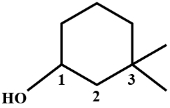
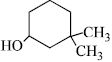
The $IUPAC$ name of the given compound is :
  • A
    $1,1-$ dimethyl $-3-$ hydroxy cyclohexane
  • B
    $3,3-$ dimethyl $-1-$ hydroxy cyclohexane
  • $3,3-$ dimethyl $-1-$ cyclohexanol
  • D
    $1,1-$ dimethyl $-3-$ cyclohexanol

Answer

Correct option: C.
$3,3-$ dimethyl $-1-$ cyclohexanol
c
Hence, IUPAC name is $3,3$-dimethyl-$1$-cyclohexanol

Need a full question paper?

Generate a complete, print-ready paper with questions like this in minutes — across 16+ boards, with answer keys.

Start Generating Free

Similar questions

The major product of the following reaction is 
Electricity required for liberating $710\, g$ of $Cl_2(g)$ by electrolyzing a concentrated solution of $NaCl$ will be
Which has minimum number of atoms of oxygen?
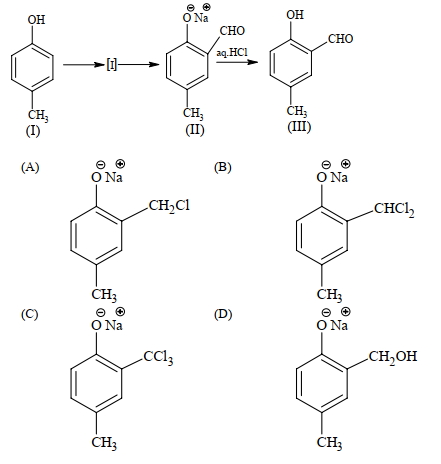
Reimer-Tiemann reaction introduces an aldehyde group, on to the aromatic ring of phenol, ortho to the hydroxyl group. This reaction involves electrophilic aromatic substitution. This is a general method for the synthesis of substituted salicyladehydes as depicted below.

$Image$

$1.$ Which one of the following reagents is used in the above reaction?

$(A)$ aq. $\mathrm{NaOH}+\mathrm{CH}_3 \mathrm{Cl}$

$(B)$ aq. $\mathrm{NaOH}+\mathrm{CH}_2 \mathrm{Cl}_2$

$(C)$ aq. $\mathrm{NaOH}+\mathrm{CHCl}_3$

$(D)$ aq. $\mathrm{NaOH}+\mathrm{CCl}_4$

$2.$ The electrophile in this reaction is

$(A)$ : $\mathrm{CHCl}$ $(B)$ ${ }^{+} \mathrm{CHCl}_2$

$(C)$ $\mathrm{CCl}_2$ $(D)$. $\mathrm{CCl}_3$

$3.$ The structure of the intermediate $I$ is

$Image$

Give the answer question $1, 2$ and $3.$
Iso-electronic species is
In which of the following solutions, ions are present
The enthalpy change $(\Delta H)$ for the reaction, $N_2 (g) + 3H_2 (g) \to 2NH_3(g)$ is $-92.38\, kJ$ at $298\, K$. The internal energy change $\Delta U$ at $298\, K$ is .............. $\mathrm{kJ}$
On complete combustion of $0.492\,g$ of an organic compound containing $C , H$ and $O , 0.7938\,g$ of $CO _{2}$ and $0.4428\,g$ of $H _{2} O$ was produced. The $\%$ composition of oxygen in the compound is $........$
$(CH_3)_2CHBr$ $\xrightarrow[{(2)\,CuI}]{{(1)\,Li}}\left( A \right)\xrightarrow{{{{\left( {C{H_3}} \right)}_2}CHC{H_2}Br}}B$

$'B'$ is

“Relative lowering in vapour pressure of solution containing non-volatile solute is directly proportional to mole fraction of solute”. Above statement is