The kinetic energy and the potential energy of a particle executing $S.H.M.$ are equal. The ratio of its displacement and amplitude will be
Medium
Download our app for free and get started
(a) Given $K.E. = P.E.$$ \Rightarrow \frac{1}{2}m{v^2} = \frac{1}{2}k{x^2}$
$ \Rightarrow \frac{1}{2}m{\omega ^2}({a^2} - {x^2}) = \frac{1}{2}m{\omega ^2}{x^2}$
$ \Rightarrow {a^2} - {x^2} = {x^2}$$ \Rightarrow {x^2} = \frac{{{a^2}}}{2}$$ \Rightarrow \frac{x}{a} = \frac{1}{{\sqrt 2 }}.$

Download our appand get started for free
Experience the future of education. Simply download our apps or reach out to us for more information. Let's shape the future of learning together!No signup needed.*
Similar Questions
- 1View SolutionIn forced oscillations, a particle oscillates simple harmonically with a frequency equal to
- 2A pendulum is hung from the roof of a sufficiently high building and is moving freely to and fro like a simple harmonic oscillator. The acceleration of the bob of the pendulum is $20\; m/s^2$ at a distance of $5\; m$ from the mean position. The time period of oscillation isView Solution
- 3A $1 \,kg$ block attached to a spring vibrates with a frequency of $1\, Hz$ on a frictionless horizontal table. Two springs identical to the original spring are attached in parallel to an $8\, kg$ block placed on the same table. So, the frequency of vibration of the $8\, kg$ block is ..... $Hz$View Solution
- 4The phase of a particle executing simple harmonic motion is $\frac{\pi }{2}$ when it hasView Solution
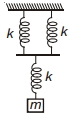
- 5A block of mass $m$ hangs from three springs having same spring constant $k$. If the mass is slightly displaced downwards, the time period of oscillation will beView Solution
- 6You are holding a shallow circular container of radius $R$, filled with water to a height $h ( h < < R )$. When yon walk with speed $v$, it is seen that water starts spilling over. This happens due to the resonance of the periodic impulse given to the container (due to walking) with the oscillation of the water in the container. If the time period of water oscillating in the container is inversely proportional to $\sqrt{ h }$, then $v$ is proportional toView Solution
- 7A uniform spring of force constant $k$ is cut into two pieces, the lengths of which are in the ratio $1 : 2$. The ratio of the force constants of the shorter and the longer pieces isView Solution
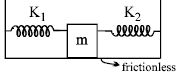
- 8Two springs with negligible masses and force constant of $K_1 = 200\, Nm^{-1}$ and $K_2 = 160\, Nm^{-1}$ are attached to the block of mass $m = 10\, kg$ as shown in the figure. Initially the block is at rest, at the equilibrium position in which both springs are neither stretched nor compressed. At time $t = 0,$ a sharp impulse of $50\, Ns$ is given to the block with a hammer.View Solution
- 9The total energy of the body executing $S.H.M.$ is $E$. Then the kinetic energy when the displacement is half of the amplitude, isView Solution
- 10A $1.00 \times {10^{ - 20}}kg$ particle is vibrating with simple harmonic motion with a period of $1.00 \times {10^{ - 5}}sec$ and a maximum speed of $1.00 \times {10^3}m/s$. The maximum displacement of the particle isView Solution