MCQ
The kinetic energy of a body decreases by $36\%$. The decrease in its momentum is ............... $\%$
  • A
    $36$
  • $20$
  • C
    $8$
  • D
    $6$

Answer

Correct option: B.
$20$
b
(b) $P = \sqrt {2\,mE} $  $\therefore P \propto \sqrt E $

In given problem $K.E.$ becomes $64\%$ of the original value.

$\frac{{{P_2}}}{{{P_1}}} = \sqrt {\frac{{{E_2}}}{{{E_1}}}} = \sqrt {\frac{{64E}}{{100E}}} = 0.8$==>${P_2} = 0.8\,P$

$\therefore {P_2} = 80\% $ of the original value.

i.e. decrease in momentum is $20\%$.

Need a full question paper?

Generate a complete, print-ready paper with questions like this in minutes — across 16+ boards, with answer keys.
Start Generating Free

Similar questions

Which pair of the following forces will never give resultant force of $2\, N$
A fighter jet is flying horizontally at a certain altitude with a speed of $200 \; ms ^{-1}$. When it passes directly overhead an anti-aircraft gun, bullet is fired from the gun, at an angle $\theta$ with the horizontal, to hit the jet. If the bullet speed is $400 \; m / s$, the value of $\theta$ will be $\dots \; {}^o$
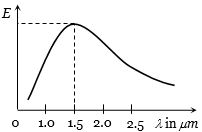
In the figure, the distribution of energy density of the radiation emitted by a black body at a given temperature is shown. The possible temperature of the black body is ....... $K$
An ice block is melting at a constant rate $\left| {\,\frac{{dm}}{{dt}}\,} \right|= \mu$ . Its initial mass is $m_0$ and it is moving with velocity on a frictionless horizontal surface. The distance travelled by it till it melts completely is :
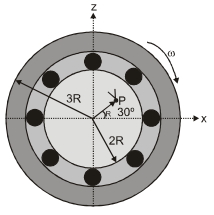
The figure shows a system consisting of $(i)$ a ring of outer radius $3 \ R$ rolling clockwise without slipping on a horizontal surface with angular speed $\omega$ and $(ii)$ an inner disc of radius $2 \ R$ rotating anti-clockwise with angular speed $\omega / 2$. The ring and disc are separated $b$ frictionaless ball bearings. The system is in the $x-z$ plane. The point $P$ on the inner disc is at distance $R$ from the origin, where $OP$ makes an angle of $30^{\circ}$ with the horizontal. Then with respect to the horizontal surface, $Image$

$(A)$ the point $O$ has linear velocity $3 R \omega \hat{ i }$.

$(B)$ the point $P$ has a linear velocity $\frac{11}{4} R \omega \hat{ i }+\frac{\sqrt{3}}{4} R \omega \hat{ k }$

$(C)$ the point $P$ has linear velocity $\frac{13}{4} R w \hat{ i }-\frac{\sqrt{3}}{4} R \omega \hat{k}$

$(D)$ The point $P$ has a linear velocity $\left(3-\frac{\sqrt{3}}{4}\right) R w_{\hat{ i }}+\frac{1}{4} R w_{\hat{k}}$.
Two particles $A$ and $B$, move with constant velocities ${\vec v_1}$ and ${\vec v_2}$. At the initial moment their position vectors are ${\vec r_1}$ and ${\vec r_2}$ respectively. The condition for their collision is
Starting from the origin at time $t=0,$ with initial velocity $5 \hat{ j }\, ms ^{-1},$ a particle moves in the $x-y$ plane with a constant acceleration of $(10 \hat{ i }+4 \hat{ j })\, ms ^{-2}$. At time $t$, its coordinates are $\left(20\, m , y _{0}\, m \right) .$ The values of $t$ and $y _{0},$ are respectively
Which one of the following statements is true for the speed $v$ and the acceleration $a$ of a particle executing simple harmonic motion
The fundamental frequency of vibration of a string stretched between two rigid support is $50\,Hz$. The mass of the string is $18\,g$ and its linear mass density is $20\,g / m$. The speed of the transverse waves so produced in the string is $..........\,ms ^{-1}$
The oscillation of a body on a smooth horizontal surface is represented by the equation $x= Acos$$\omega t$ 

where $x=$ displacement at time $t$

$\omega =$ frequency of oscillation

Which one of the following graphs shows correctly the variation $a$ with $t$ ?

Here $a=$ acceleration at time $t$

$T=$ time period