The kinetic energy of $SHM$ is $1/n$ time its potential energy. If the amplitude of the $SHM$ be $A$, then what is the displacement of the particle?
Medium
Download our app for free and get started
$\mathrm{K}=\frac{1}{\mathrm{n}} \mathrm{up} \Rightarrow \frac{1}{2} \mathrm{m} \omega^{2}\left(\mathrm{A}^{2}-\mathrm{x}^{2}\right)=\frac{1}{\mathrm{n}} \frac{1}{2} \mathrm{m} \omega^{2} \mathrm{x}^{2}$
that $A^{2}-x^{2}=\frac{x^{2}}{n} \quad$ or $x^{2}\left(1-\frac{1}{n}\right)=A^{2}$
$x=\sqrt{\frac{n}{n+1}} A$

Download our appand get started for free
Experience the future of education. Simply download our apps or reach out to us for more information. Let's shape the future of learning together!No signup needed.*
Similar Questions
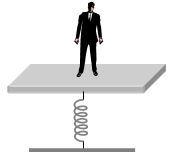
- 1A man weighing $60\, kg$ stands on the horizontal platform of a spring balance. The platform starts executing simple harmonic motion of amplitude $0.1\, m$ and frequency $\frac{2}{\pi }Hz$. Which of the following statement is correctView Solution
- 2The resultant of two rectangular simple harmonic motions of the same frequency and unequal amplitudes but differing in phase by $\frac{\pi }{2}$ isView Solution
- 3A mass $0.9\,kg$, attached to a horizontal spring, executes $SHM$ with an amplitude $A _{1}$. When this mass passes through its mean position, then a smaller mass of $124\,g$ is placed over it and both masses move together with amplitude $A _{2}$. If the ratio $\frac{ A _{1}}{ A _{2}}$ is $\frac{\alpha}{\alpha-1}$, then the value of $\alpha$ will be$......$View Solution
- 4A particle performs simple harmonic motion with amplitude A. Its speed is increased to three times at an instant when its displacement is $\frac{2 \mathrm{~A}}{3}$. The new amplitude of motion is $\frac{\mathrm{nA}}{3}$. The value of $\mathrm{n}$ is____.View Solution
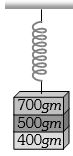
- 5Three masses $700g, 500g$, and $400g$ are suspended at the end of a spring a shown and are in equilibrium. When the $700g$ mass is removed, the system oscillates with a period of $3$ seconds, when the $500 \,gm$ mass is also removed, it will oscillate with a period of ...... $s$View Solution
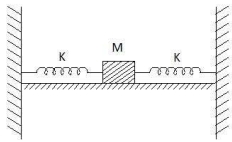
- 6In the figure given below. a block of mass $M =490\,g$ placed on a frictionless table is connected with two springs having same spring constant $\left( K =2 N m ^{-1}\right)$. If the block is horizontally displaced through ' $X$ 'm then the number of complete oscillations it will make in $14 \pi$ seconds will be $.........$View Solution
- 7The equation of motion of a particle is $\frac{{{d^2}y}}{{d{t^2}}} + Ky = 0$, where $K$ is positive constant. The time period of the motion is given byView Solution
- 8Time period of a particle executing $SHM$ is $8\, sec.$ At $t = 0$ it is at the mean position. The ratio of the distance covered by the particle in the $1^{st}$ second to the $2^{nd}$ second is :View Solution
- 9When an oscillator completes $100$ oscillations its amplitude reduced to $\frac{1}{3}$ of initial value. What will be its amplitude, when it completes $200$ oscillations?View Solution
- 10When a mass $m$ is hung from the lower end of a spring of neglibgible mass, an extension $x$ is produced in the spring. The time period of oscillation isView Solution