MCQ
The lamp whose working is based on a discharge tube is $.......$:
  • A
    Fluorescent lamp
  • B
    Incandescent lamp
  • C
    $\text{CFL}$
  • Both $(A)$ and $(C)$

Answer

Correct option: D.
Both $(A)$ and $(C)$

Fluroscent lamp and compact fluroscent lamp works based on the low pressure gas discharge principle.
The glass tube if low pressure gas discharge lamp is filled with noble gas at low pressure and small quantity of mercury.

Need a full question paper?

Generate a complete, print-ready paper with questions like this in minutes — across 16+ boards, with answer keys.
Start Generating Free

Similar questions

In Millikan's oil drop experiment an oil drop carrying a charge $Q$ is held stationary by a potential difference $2400\,V$ between the plates. To keep a drop of half the radius stationary the potential difference had to be made $600\,V$. What is the charge on the second drop
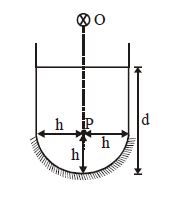
A concave mirror of radius $h$ is placed at the bottom of a tank containing a liquid of refractive index $μ$ upto a depth $d$ . An object $P$ is placed at height $h$ above the bottom of the mirror. Outside the liquid, an observer $O$ views the object and its image in the mirror. The apparent distance between these two will be
A person has been using spectacles of power- $1.0$ diopter for distant vision and a separate reading glass of power $2.0$ diopters. What is the least distance of distinct vision for this person $.......cm$
Find the value of x in the following nuclear reaction. ${ }_7 \mathrm{~N}^{14}+{ }_2 \mathrm{He}^4 \rightarrow \mathrm{xO}^{17}+{ }_1 \mathrm{H}^1$
Heater of electric kettle is made of a wire of length $L$ and diameter $d$. It takes $4$ minutes to raise the temperature of $0.5 \ kg$ water by $40\ K$. This heater is replaced by a new heater having two wires of the same material, each of length $L$ and diameter $2 d$. The way these wires are connected is given in the options. How much time in minutes will it take to raise the temperature of the same amount of water by $40K$ ?

$(A)$ $4$ if wires are in parallel

$(B)$ $2$ if wires are in series

$(C)$ $1$ if wires are in series

$(D)$ $0.5$ if wires are in parallel.

When light enters from air to water, then its
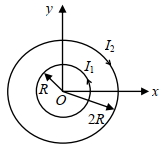
Two concentric circular loops, one of radius $R$ and the other of radius $2 R$, lie in the $x y$-plane with the origin as their common center, as shown in the figure. The smaller loop carries current $I_1$ in the anti-clockwise direction and the larger loop carries current $I_2$ in the clockwise direction, with $I_2>2 I_1 . \vec{B}(x, y)$ denotes the magnetic field at a point $(x, y)$ in the $x y$-plane. Which of the following statement($s$) is(are) current?

$(A)$ $\vec{B}(x, y)$ is perpendicular to the $x y$-plane at any point in the plane

$(B)$ $|\vec{B}(x, y)|$ depends on $x$ and $y$ only through the radial distance $r=\sqrt{x^2+y^2}$

$(C)$ $|\vec{B}(x, y)|$ is non-zero at all points for $r$

$(D)$ $\vec{B}(x, y)$ points normally outward from the $x y$-plane for all the points between the two loops
A particle of mass $m$ having negative charge $q$ move along an ellipse around a fixed positive charge $Q$ so that its maximum and minimum distances from fixed charge are equal to $r_1$ and $r_2$ respectively. The angular momentum $L$ of this particle is
Emf is most closely related to
The current in a conductor is expressed as $I=3 t^2+4 t^3$, where $I$ is in Ampere and $t$ is in second. The amount of electric charge that flows through a section of the conductor during $t=1$ s to $t=2 \mathrm{~s}$ is_______ C.