MCQ
When light enters from air to water, then its
  • A
    Frequency increases and speed decreases
  • Frequency is same but the wavelength is smaller in water than in air
  • C
    Frequency is same but the wavelength in water is greater than in air
  • D
    Frequency decreases and wavelength is smaller in water than in air
Answer

Correct option: B.
Frequency is same but the wavelength is smaller in water than in air
b
( b)

Need a full question paper?

Generate a complete, print-ready paper with questions like this in minutes — across 16+ boards, with answer keys.

Start Generating Free

Similar questions

Both the nucleus and the atom of some element are in their respective first excited states. They get de-excited by emitting photons of wavelengths $\lambda _N,\,\lambda _A$  respectively. The ratio $\frac{{{\lambda _N}}}{{{\lambda _A}}}$  is closest to
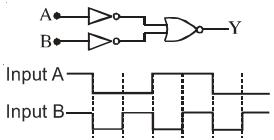
The logic circuit shown below has the input waveforms '$A$' and '$B$' as shown. Pick out the correct output waveform. 
The electric field in a plane electromagnetic wave is given by

$\overrightarrow{{E}}=200 \cos \left[\left(\frac{0.5 \times 10^{3}}{{m}}\right) {x}-\left(1.5 \times 10^{11} \frac{{rad}}{{s}} \times {t}\right)\right] \frac{{V}}{{m}} \hat{{j}}$

If this wave falls normally on a perfectly reflecting surface having an area of $100 \;{cm}^{2}$. If the radiation pressure exerted by the $E.M.$ wave on the surface during a $10\, minute$ exposure is $\frac{{x}}{10^{9}} \frac{{N}}{{m}^{2}}$. Find the value of ${x}$.

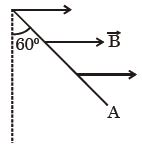
Find .......$Wb/m^2$ the magnetic flux density, if a flux of $2 \times 10^{-3}$ $weber$ passes through the slant area $A = 10\, cm^2$
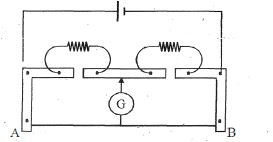
A meter bridge set up as shown to determine end correction at $A$ and $B$ . When a resistance of $15\,\Omega $ is used in left gap and of $20\,\Omega $ in right gap, then null point comes at a distance $42\ cm$ from $A$ . When these resistances are interchanged null point comes at a distance $57\ cm$ from $A$ . Values of end corrections are
In a radioactive material the activity at time $t_1$ is $R_1$ and at a later time $t_2$ it is $R_2$. If the decay constant of the material is $\lambda$ then
Total internal reflection can take place only if:
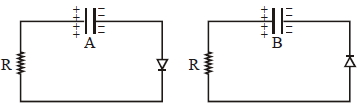
Two identical capacitors $\mathrm{A}$ and $\mathrm{B}$, charged to the same potential $5\; \mathrm{V}$ are connected in two different circuits as shown below at time $\mathrm{t}=0$ If the charge on capacitors $A$ and $B$ at time $\mathrm{t}=\mathrm{CR}$ is $\mathrm{Q}_{\mathrm{A}}$ and $\mathrm{Q}_{\mathrm{B}}$ respectively, then (Here $e$ is the base of natural logarithm)
An electron collides with a free molecule initially in its ground state. The collision leaves the molecule in an excited state that is metastable and does not decay to the ground state by radiation. Let $K$ be the sum of the initial kinetic energies of the electron and the molecule and $p$ be the sum of their initial momenta. Let $K^{\prime}$ and $p ^{\prime}$ represent the same physical quantities after the collision. Then,
The potential gradient along the length of a uniform wire is 10 volt/metre. B and C are the two points at 30 cm and 60 cm point on a meter scale fitted along the wire. The potential difference between B and C will be