The length of a potentiometer wire is $\ell $. A cell of emf $E$ is balanced at a length $\ell /3$ from the positive end of the wire. If the length of the wire is increased by $\ell /2$ at what distance will the same cell give a balanced point
Medium
Download our app for free and get started
$\mathrm{E}=\mathrm{x} \ell_{1}=\frac{\mathrm{V}}{\ell} \ell_{1}=\frac{\mathrm{V}}{\ell}\left(\frac{\ell}{3}\right)$ ..........$(1)$
$\ell=$ length of wire
again ${\rm{E}} = {{\rm{x}}^\prime }{\ell ^\prime } = \frac{{\rm{V}}}{{3\ell /2}}{\ell ^\prime }$ .......$(2)$
Divided eq. $(1)$ by $(2)$
$\ell^{\prime}=\ell / 2$

Download our appand get started for free
Experience the future of education. Simply download our apps or reach out to us for more information. Let's shape the future of learning together!No signup needed.*
Similar Questions
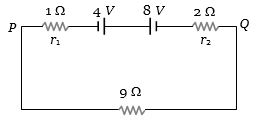
- 1Two batteries of $e.m.f.$ $4\,V$ and $8 \,V$ with internal resistances $1\, \Omega$ and $2\,\Omega$ are connected in a circuit with a resistance of $9 \,\Omega$ as shown in figure. The current and potential difference between the points $P$ and $Q$ areView Solution
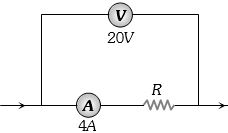
- 2In the diagram shown, the reading of voltmeter is $20\, V$ and that of ammeter is $4\, A$. The value of $R$ should be (Consider given ammeter and voltmeter are not ideal)View Solution
- 3A potentiometer wire is $100\,\, cm$ long and a constant potential difference is maintained across it. Two cells are connected in series first to support one another and then in opposite direction. The balance points are obtained at $50\,\, cm$ and $10\,\, cm$ from the positive end of the wire in the two cases. The ratio of emf's isView Solution
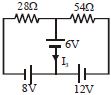
- 4Consider the circuit shown in the figure. The current $I_3$ is equal toView Solution
- 5In a potentiometer wire experiment the $\mathrm{emf}$ of a battery in the primary circuit is $20\,V$ and its internal resistance is $5\,\Omega$ . There is a resistance box in series with the battery and the potentiometer wire, whose resistance can be varied from $120\,\Omega$ to $170\,\Omega$ . Resistance of the potentiometer wire is $75\,\Omega$ . The following potential differences can be measured using this potentiometer.View Solution
- 6A cylindrical metal wire of length $l$ and cross sections area $S$, has resistance $R$, conductance $G$, conductivity $\sigma$ and resistivity $\rho$. Which one of the following expressions for $\sigma$ is validView Solution
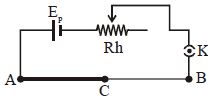
- 7A potentiometer consists of two wires $AC$ and $CB$ of same material and of equal lengths but diameters in the ratio $3 : 1.$ Then the potential gradients on the two wires will be in the ratio :-View Solution
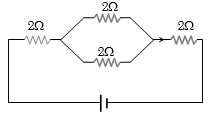
- 8The equivalent resistance of the circuit shown in the figure is ............. $\Omega$View Solution
- 9View SolutionA potential difference is applied across the ends of a metallic wire. If the potential difference is doubled, then the drift velocity
- 10An ideal gas mixture filled inside a balloon expands according to the relation $PV^{2/3} =$ constant. The temperature inside the balloon isView Solution