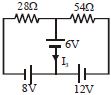
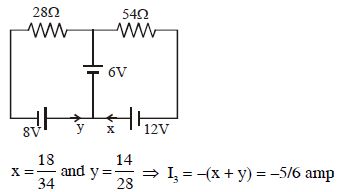
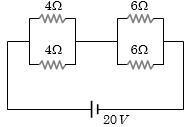
Consider the circuit shown in the figure. The current $I_3$ is equal to
Medium


Download our appand get started for free
Experience the future of education. Simply download our apps or reach out to us for more information. Let's shape the future of learning together!No signup needed.*
Similar Questions
- 1The charge flowing through a resistance $R$ varies with time according to $Q = at -bt^2.$ The total heat produced in $R$ is : (assume that direction of current not reversed)View Solution
- 2Two equal resistances when connected in series to a battery, consume electric power of $60\,W.$ If these resistances are now connected in parallel combination to the same battery, the electric power consumed will be .............. $W$View Solution
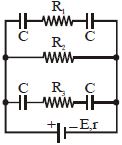
- 3In the circuit diagram of figure, $E = 5\, volt, r = 1\, \Omega ,$$ R_2 = 4\, \Omega , R_1 = R_3 = 1 \Omega$ and $C = 3\, μF.$ Then the magnitude of the charge on each capacitor plate is......$\mu C$View Solution
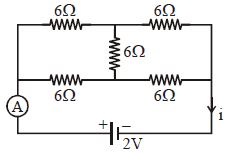
- 4View SolutionReading of ammeter in ampere for the following circuit is
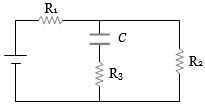
- 5In the circuit here, the steady state voltage across capacitor $C$ is a fraction of the battery $e.m.f.$ The fraction is decided byView Solution
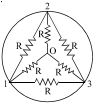
- 6Inside $a$ super conducting ring six identical resistors each of resistance $R$ are connected as shown in figure. The equivalent resistance $(s)$View Solution
- 7The current flowing through $R _2$ is:View Solution
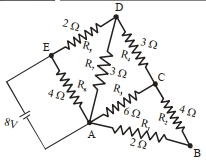
- 8Four resistances are connected in a circuit in the given figure. The electric current flowing through $4\, ohm$ and $6\, ohm$ resistance is respectivelyView Solution
- 9Consider a metallic cube of edge length $L$. Its resistance, $R$, measured across its opposite faces is $R =\frac{ m _{ e } v }{ ne ^2 L ^2}$, where $n$ is the number density and $v$ is the drift speed of electrons in the cube, and $e$ and $m _{ e }$ are the charge and mass of an electron respectively. Assuming the de-Broglie wavelength of the electron to be $L$, the maximum resistance of the sample is closest to ............. $\,\Omega$ $\left(e=1.60 \times 10^{-19} \,C ; m _{ e }=9.11 \times 10^{-31} \,kg\right.$; Planck's constant, $h=6.63 \times 10^{-34} \,Js$ )View Solution
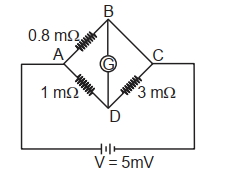
- 10To measure the temperature coefficient of resistivity $\alpha$ of a semiconductor, an electrical arrangement shown in the figure is prepared. The arm BC is made up of the semiconductor. The experiment is being conducted at $25^{\circ} \mathrm{C}$ and resistance of the semiconductor arm is $3 \mathrm{~m} \Omega$. Arm BC is cooled at a constant rate of $2^{\circ} \mathrm{C} / \mathrm{s}$. If the galvanometer $\mathrm{G}$ shows no deflection after $10 \mathrm{~s}$, then $\alpha$ is :View Solution